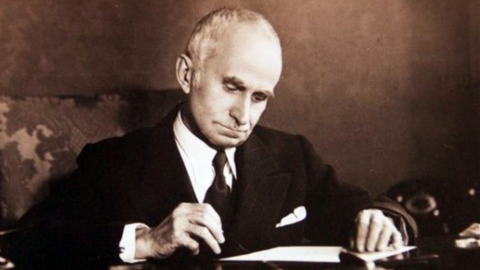
Italians easily forget lessons of history. And even more, they tend to chase from their thoughts many of the great masters of the past who investigated the nature of peoples, the economic laws that govern progress, the political and moral strength necessary to achieve the general interest with foresight.
Luigi Einaudi he is certainly among the great masters of contemporary Italy. Economist, but also journalist, politician, man of strong convictions and infinite patience with which he has always tried to inform citizens about the laws that regulate civil life, about the real interests of people who must avoid being attracted by the sirens of demagogy. The solemn celebration of the was held in Rome, in the Campidoglio 150 years from birth of the great man of culture who was, as will be remembered, the first president of the Republic of the newborn Italian democracy after the Constitution had been approved. Previously, immediately after the end of World War II and the fall of fascism, to which Einaudi had always been in opposition, had contributed as Governor of the Bank of Italy to economic stabilization and had laid the foundations for the subsequent boom which in the sixties had transformed Italy from an underdeveloped agricultural country into one of the major industrial economies of Europe.
Einaudi: useless sermons are treasure chests of great wisdom
Einaudi, as underlined by the Governor of the Bank of Italy, Fabio Panetta, had known how to lower his great economic doctrine in the reality of the concrete situation of the country. He was a wise and prudent observer of our vices and virtues. He never tired of showing our fellow citizens the most reasonable solution to the problems that gradually arose. His famous ones"Useless sermons “ they were the sign of the need not to give in to discouragement, to overcome pessimism with reasonableness, to have trust in democracy representative which, with all its defects, is certainly better and even more efficient than authoritarian and technocratic regimes.
And this is the first lesson among the many that Einaudi left us, and which is extremely relevant at this moment. Many of the current admirers of Putin and the strong man in command should reflect on the fact that authoritarian regimes can only stay afloat by deceiving the people, on the promise of protection and efficiency of the public machine which in reality does not exist.
Einaudi: "the European Union is necessary to avoid the disappearance of individual states"
Connected to the defense of democracy is Einaudi's profound conviction on the need for overcome nationalism and autarkic closures to create aXNUMX-XNUMX business days equipped with powers ceded by individual states. The problem – you wrote – is not that of maintaining the independence of individual states with respect to the transfer of powers to the European Union, but that of be united or disappear. No European country alone can bear the cost of autonomous defense. Not only that, but he invoked the need for politicians and citizens to be able to seize the fleeting moment, that is, the moment in which challenging choices must be made to secure a place in the world. If we let this moment pass we risk falling into a long phase of decadence as happened in Italy on the threshold of the 500th century when many small states could not find any agreement and ended up under the influence of this or that great power. It seems to have been written today after the recent Brussels summit from which no decisions came out that were up to the level of the global situation.
From a strictly economic point of view, Einaudi's lesson is of pressing relevance on many issues. First of all the monetary stability and the need for keep accounts in order public with policies that are not blood and tears at all, but which if well articulated can achieve important results in the general interest and not of individual corporations. Moreover, in the immediate post-war period his decisions as Governor of the Bank of Italy rthey established the value of the currency without causing too much damage to the real economy. It would therefore be useful if on the one hand the current governments implemented Enaudian recipes to keep public finances in order while reducing the perimeter of the public sector. The ECB for its part should proceed with a gradual and controlled reduction in rates, given that inflation is under control, to avoid having too negative repercussions on production and employment.
Einaudi's main lesson is contained in his famous motto: "know to decide”. The ruling classes should study the situation carefully before making decisions which in the short term may even seem interesting and positive, but which in the short space of a few years can show their disastrous face. The question of the superbonus110% it should certainly lead us to some more careful reflection before taking action. Or to vote for those who propose them.