When we think of Republic Day, our thoughts immediately turn to the referendum of June 2, 1946, the birth of Italian democracy, and the official celebrations held annually in Rome. Yet, looking at this event through the eyes of an art historian, a different perspective emerges: June 2nd appears as an extraordinary visual construction, a narrative made up of symbols, images, and rituals that, over the course of eighty years, have helped define the Republic's cultural identity. Nations, in fact, do not exist solely through laws and institutions. Like every great civilization, they tell their story through shared images. Art has always had the task of shaping collective values: just think of the medieval frescoes that represented religious power or the Renaissance monuments that celebrated the prestige of cities. Likewise, the Italian Republic has developed its own iconography over time, made up of places, colors, and symbols that reappear each year during the June 2nd celebrations.
The first of these places is undoubtedly the Altar of the Fatherland
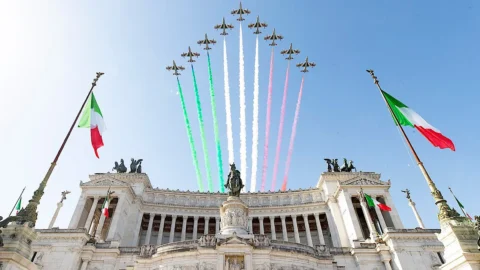
Located in the heart of Rome, the Vittoriano dominates Piazza Venezia with its monumental grandeur. Built to celebrate the unification of Italy, the complex has gradually taken on a new meaning, becoming the Republic's principal symbolic theater. Each year, the President of the Republic pays homage to the Unknown Soldier in a ceremony with the solemnity of an ancient rite. The architectural space, designed to inspire wonder and respect, is thus transformed into a place of active remembrance, where the language of monumental art dialogues with that of the citizenry. It is striking how this monument continues to fulfill the function for which it was conceived: to transform an abstract idea, in this case the nation, into a concrete visual experience. The grand staircases, allegorical statues, dramatic perspectives, and the use of white marble combine to create an almost theatrical effect, which reaches its peak during the June 2nd celebrations.
The military parade along the Imperial Forums can be interpreted as a form of artistic representation
Uniforms, banners, synchronized movements, and ceremonial processions create a collective choreography reminiscent of the great public demonstrations in European history. It's not simply a demonstration of organizational efficiency: it's a visual composition designed to communicate values such as unity, discipline, and belonging. Of all the images that characterize Republic Day, perhaps none possesses the evocative power of the Frecce Tricolori. As the planes streak across the sky, leaving green, white, and red trails in their wake, we witness a sort of contemporary artistic performance. The sky becomes a temporary canvas on which the nation's most recognizable symbol is painted. For a few minutes the Tricolour abandons its traditional form and transforms into gesture, movement and spectacle. This ability to transform a political symbol into an aesthetic image is one of the most fascinating aspects of Republic Day. The national colors aren't simply displayed; they're put on display. They illuminate public buildings, decorate squares and monuments, sweep across the Roman sky, and become the focus of television broadcasts that reach millions of citizens.
The Republic's visual heritage is not limited to contemporary celebrations
Its roots lie in the photographs of the 1946 referendum. The archives of the era preserve extraordinary images: women voting for the first time, citizens waiting in front of polling stations, election posters, and squares alive with renewed enthusiasm. These shots are not merely historical documents. They are images that have contributed to building the country's collective memory. As with great works of art, some of these photographs have acquired a symbolic value over time that transcends their original meaning. They tell the story of the birth of a new idea of citizenship and represent the moment when millions of Italians began to imagine their future as members of a democratic community. In this sense, Republic Day doesn't simply celebrate a political event. It celebrates the ability of images to build identities. Nations need shared symbols as much as they need institutions. Without images capable of representing them, ideas risk remaining abstract. Art therefore plays a fundamental role: it makes values such as freedom, equality, and participation visible.
A celebration as a great collective work
Looking at June 2nd through this lens, the Republic appears as a great collective work, created not by a single artist but by the entire national community. Monuments, photographs, music, flags, and ceremonies are the pieces of a narrative that is renewed every year and continues to speak to new generations. Perhaps this is the true strength of Republic Day: the ability to transform history into images and memory into shared experience. An open-air museum that, every June 2nd, reminds Italians not only of who they were, but also of what they desire to continue to be.