

It's not just a question of engines, performance, or design. In the classic car market, value is increasingly measured through a combination of factors: rarity, authenticity, provenance, state of preservation, and cultural significance. The international auctions in September and October 2026 offer an interesting glimpse into this evolution, confirming the centrality of certain Italian and European brands in the global collecting landscape. Ferrari, Lamborghini, Mercedes-Benz, Aston Martin, and Porsche continue to represent the most recognizable names in a market where the automobile has progressively transcended its original function to become a collector's item, a testament to an era, and, for some buyers, even a form of wealth diversification.
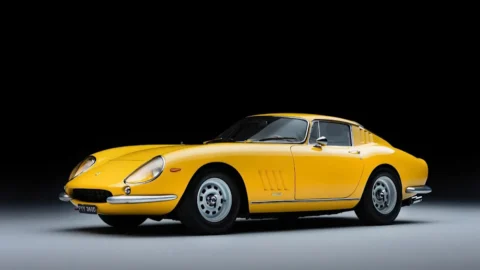
Among the most significant results of the autumn is the 1965 Ferrari 275 GTB Alloy, offered by RM Sotheby's in London
The With its aluminum body, it represents one of the most sought-after expressions of Ferrari production in the 1960s. Its appeal lies not only in its technical features, but also in its combination of limited production, stylistic identity, and industrial history.
Another model that continues to exert a strong attraction is the Ferrari F40
Presented in 1987 to celebrate the Maranello-based manufacturer's fortieth anniversary, it has become a symbol of contemporary automotive culture. Its presence at high-end auctions demonstrates how even cars from the 1980s and 1990s are consolidating their important position among international collectors. This is a significant shift: the market no longer looks exclusively at cars from the golden age of the 1950s and 1960s, but also recognizes value in more recent models, provided they possess a strong historical and design identity.
Alongside Ferrari, the Lamborghini Miura holds a special role
The car, born in the late 1960s, transformed the very language of the sports car, introducing a technical and stylistic concept that would influence subsequent generations. Its importance also lies in its ability to represent a turning point in Italian industrial history: engineering innovation, formal research, and entrepreneurial vision combined to create an object that has become an icon. Internationally, the Mercedes-Benz 300 SL, the Aston Martin DB4 and DB5, and the rarest versions of the Porsche 911 confirm the solid demand for models that have shaped the history of European motoring. These cars maintain strong international recognition and benefit from a consolidated community of collectors. To understand the dynamics of this market, however, we must look beyond the price tag. Two examples of the same model can achieve vastly different valuations. The price is determined by the chassis number, the correspondence of original components, the history of ownership, restoration work, available documentation, and, above all, the preservation of the original features.
Provenance has become an essential element
A car with a verifiable history, consistent documentation, and authoritative certification offers greater guarantees than one with a fragmented history. In an industry where authenticity is integral to economic value, the quality of information has become a market component. Auction houses have also assumed an increasingly complex role. They no longer simply connect sellers and buyers, but also construct valorization paths through documentary research, specialized catalogs, technical inspections, and presentations capable of conveying the historical significance of the vehicles. Car collecting also has an economic dimension that involves a much broader supply chain than the sale and purchase of goods. Restorers, body shops, specialized mechanics, archivists, historical documentation experts, museums, and event organizers contribute to the preservation of a wealth of expertise that would otherwise risk being lost.
This is particularly relevant for Italy, where the history of the automobile is closely linked to industrial development, design creativity, and regional culture. Ferrari, Lamborghini, Maserati, and Alfa Romeo are more than just trademarks: they represent a recognizable part of Italy's manufacturing identity and its ability to compete on international markets through quality and research.
The growing interest in youngtimers, cars from the 1980s and 1990s that are now entering the collector's circuit, is also introducing new generations of buyers. This change is broadening the market, altering selection criteria, and leading to a reevaluation of models that until just a few years ago were simply considered high-end used cars.
Investment yes, but without automatic mechanisms
Considering a classic car as an investment requires caution. Liquidity is limited compared to traditional financial markets, maintenance and upkeep costs can be high, and valuations depend on characteristics that are difficult to standardize. Not all vehicles increase in value, and not every record-breaking result is a replicable indicator.
The market rewards selectivity above all: rare models, authentic pieces, important provenances, and solid documentary evidence. The emotional dimension remains central, but is increasingly accompanied by an analytical and patrimonial approach.
The autumn 2026 auctions ultimately suggest that car collecting isn't just about nostalgia for an industrial past. It's a market where capital, culture, technology, and memory converge. And where time, rather than eroding an object's value, can help build it.