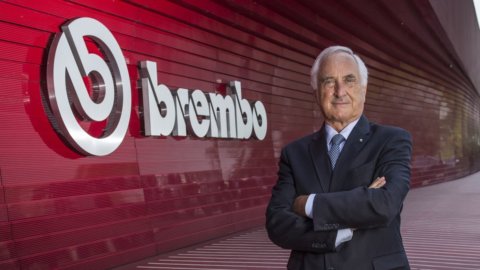
What's the secret that allows a small or even very small company to grow over time and become a medium-sized enterprise, even entering the magical world of multinationals? Of course, there's no one-size-fits-all recipe, but the story that...Paolo Bricco, correspondent of the Sole 24 Ore and one of the most brilliant journalists of the middle generation, in his new book “Brembo. The speed of the brakes", published by Il Mulino (244 pages, €27) offers more than a clue. It's a fascinating business story that Bricco's clarity of exposition makes more intriguing than a novel, engaging the reader page after page.
The success story of Brembo is not only fascinating but also emblematic of that hidden treasure of the Italian economy which is the so-called Fourth capitalism, that world of medium-sized manufacturing companies which, all things considered, has proven to be the most dynamic segment of Italian industry and which for years has outperformed the increasingly rare large companies, whether public or private, and, it goes without saying, small and very small businesses.
Bricco has been taking Brembo by the hand since the early 1960s, in the midst of the economic boom, when Emilio Bombassei, Alberto's father, "buys a lathe, a drill press and a milling machine. And, together with Italo Breda, brother of his wife Norina, he founds the original nucleus of the future Brembo, called Officine Meccaniche di Sombreno", active in the province of BergamoIt all started in a two-room stable, and the future Brembo was nothing more than a small artisanal company. But the hallmarks of future success were all there: a passion for mechanics and manufacturing, a taste for entrepreneurship and hard work, a focus on technological innovation, and, little by little, commercial prowess. Things weren't all plain sailing at the beginning, and Alberto Bombassei, who later became Brembo's true boss, recalls how many times Fiat slammed the door in his face, even though the company was already producing quality disc brakes in the 1970s. But, as he once mercilessly said, Cesare Romiti: “Brembo is a German company that happens to be located in the province of Bergamo”. Woe betide anyone who gives up and In 1964, the supply contract with Alfa Romeo (which was then public) arrived, followed by collaborations with Moto Guzzi, Ducati, and Laverda. Brembo's intersection between cars and motorcycles and its strong identity represented by disc brakes began to make the Bergamo-based company soar, and in 1975, it began collaborating with theClassic Ferrari for sale with a bond that becomes ever deeper, blessed by the meeting in Fiorano between Alberto Bombassei and the legendaryEnzo Ferrari Then comes the increasingly close collaboration with the Porsche, the American adventure, the listing in Bag and the conquest of foreign markets. All the major car and motorcycle manufacturers buy Brembo brakes. Innovation and internationalization are the paradigm of Brembo's success, which is no longer the "pocket multinational" it was once described as. Peppino Turani but a multinational company in the round that knows how to ride globalization as well as an excellence of Made in Italy that even that visionary had fallen in love with Sergio MarchionneIn the Fourth Capitalism, not everyone has achieved the success of Brembo, but the history of the Bergamo-based company is a textbook example of a family-run capitalism that has never closed in on itself or demonized finance, but that, step by step, has gone and continues to conquer the world. Even if politicians don't seem to notice.