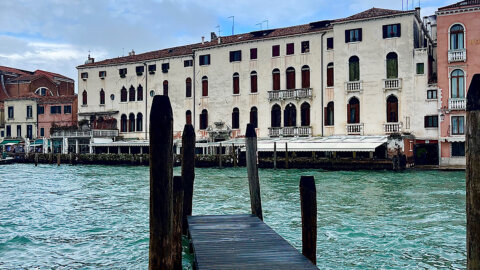
“It will be definitively lost” he wrote a few weeks ago Scientific Reports speaking of Venice, proposing even “relocation” as a long-term adaptation strategy, that is, the transfer of entire urban centres in areas far from water. This is an extreme hypothesis, but it appears to have been seriously considered for other cities threatened by flooding, such as New Orleans and Jakarta. But how can St. Mark's Basilica be dismantled and protected from exceptionally high waters, along with the lagoon city's many churches and historic buildings? The MOSE system is performing its task admirably, although some areas (first and foremost St. Mark's itself) remain at high risk even in cases of less exceptional high waters.
UNESCO, Save Venice and the countless committees that sprung up like mushrooms, especially after the terrible flood of '66, mobilised a huge amount of private funding overshadowing, if not completely obscuring, the public role in the protection and safeguarding of Venice's works of art and architecture. The role of theCentral Institute for Restoration of Rome (ICR) prestigious institution created in 39 by Cesare Brandi and today part of the General Directorate of Archaeology, Fine Arts and Landscape and the Department for the Protection of Cultural Heritage of the Ministry of Culture.
In a month in which Venice is almost entirely occupied by the events of the Biennial “In minor Keys” and from the many exhibitions set up: Punta della Dogana (Simpson and Nazareth), Palazzo Grassi (Michael Armitage), Ca' Pesaro (Jenny Saville), Gallerie dell'Accademia (Marina Abramovic), Guggenheim (London birth of a collector) Bevilacqua La Masa (Picasso, Morandi, Parmiggiani) the restoration institute, far from the spotlight, is patiently working to "save" from progressive deterioration a series of frescoes in the Golden Chapel of the church of San Zaccaria.
The cleaning of Andrea Del Castagno's frescoes is currently in full swing. Following the restoration of the three Vivarini polyptychs, work is underway on Andrea del Castagno's frescoes in the Golden Chapel, a work that chronicles the transition from the Gothic to the Renaissance. Following a negotiated procedure, the work was handed over in early 2025, with completion expected by 2026. The project was designed by the ICR together with the Superintendency of Archaeology, Fine Arts and Landscape of the City of Venice, the Patriarchate of Venice, and the International Private Committees for the Safeguarding of Venice.
A year of research, archival research, microclimate monitoring, diagnostic analysis, and cleaning trials were required. The Central Institute for Restoration then experimented with a new laser technology developed by an Italian company for Andrea del Castagno's frescoes. This technology allows for extremely selective cleaning, removing altered layers and revealing the original colors and perspectives. This technology avoids contact with water and is much more effective than the chemical methods used to date.
As the professor explains Francesca Romana Liserre, which coordinates the work for the ICR, the Chapel of San Tarasio was built and decorated between 1440 and 1443 at the initiative of Abbess Elena Foscari, sister of Doge Francesco, the longest-reigning doge in the history of the Serenissima. The chapel replaced the central apse of the first church of San Zaccaria, a building likely dating back to the 9th century and completely rebuilt in the Romanesque period after a fire in 1105. However, starting in 1460, the Romanesque church was almost completely demolished to make way for the current building. The intervention, however, spared the Chapel of San Tarasio, which from then on served as a sort of space adjacent to the new apse and accessible for devotional purposes by the Benedictine nuns who populated the convent of San Zaccaria.
Some of the most representative artists of the Italian art scene were called upon to decorate the polygonal structure of the Gothic chapel, built between 1440 and 1443. A young Andrea del Castagno, recently active in Florence, was entrusted with the frescoes that embellish the vault's ribs and the entrance arch to the apse. The painter included the figures of the Eternal Father flanked by the four Evangelists, Saint John the Baptist, and his father, Saint Zacharias.
The imposing complex celebrated the importance and prestige enjoyed by the church and the adjoining convent of San Zaccaria during the reign of Doge Foscari. Due to its proximity to St. Mark's Basilica and its possession of the most important collection of relics in Venice, the church was considered a sort of second doge's chapel, the destination of processions and visits involving the doges themselves. Most of the relics of San Zaccaria were gathered in the Chapel of San Tarasio, where they were housed in the reliquary cabinet set up behind the Polyptych of the Virgin and in the two side altars.
All the restoration interventions on Andrea del Castagno's cycle since the mid-19th century have aimed to restore the painting's readability. Besides the 19th-century intervention reported by Mario Salmi in 1958, the first documented restoration dates to 1929, followed by Leonetto Tintori's restoration between 1955 and 1956, and finally by Paolo Mora's intervention by the Central Institute for Restoration in 1970-71. The last intervention, carried out by the Corest Consortium (dated to 1994 and funded by the Dutch Committee), documents the cyclical need to intervene on the surfaces at short intervals and, at the same time, the existence of conservation issues related to the interaction between the environment and the painted surfaces. The challenge of the current intervention, adds Liserre, is precisely to delineate, quantify, and, as far as possible, limit the negative consequences of the interactions between the environment and the surfaces, using previously unavailable materials and investigation technologies.