The “Machines à penser” exhibition arrives in Venice, at the headquarters of the Prada Foundation in the lagoon city. The exhibition, curated by Dieter Roelstraete, will be open to the public from Saturday 26 May to 25 November 2018 inside the Ca' Corner della Regina palace.
The project explores the correlation between the conditions of exile, escape and retreat and the physical or mental places that favor reflection, thought and intellectual production. “Machines à penser” focuses on three fundamental figures of XNUMXth century philosophy: Theodor W. Adorno (1903 -1969), Martin Heidegger (1889 – 1976) and Ludwig Wittgenstein (1889 -1951).
The latter two philosophers shared throughout their lives the need to create one's own place of intellectual isolation: Heidegger he spent long periods of his maturity in a cabin in Todtnauberg in the Black Forest in Germany, while Wittgenstein he retired in several moments of his existence to a refuge located in a fjord in Skjolden in Norway.
In the case of Ornament instead, the condition of exile that the German philosopher experiences is analysed, due to the affirmation of Nazism in Germany, first in Oxford and then in Los Angeles, where he writes "Minima moralia", a set of aphorisms that investigate among others fear that of the fate of forced emigration. Following these reflections, the Scottish artist and poet Ian Hamilton Finlay created Adorno's Hut in 1987, a central installation within the exhibition together with the architectural reconstructions of the places of retreat in which Heidegger and Wittgenstein wrote their respective fundamental works "Being and Tempo” (1927) and “Tractatus Logico-Philosophicus” (1921).
Exposed in the spaces of Ca' Corner della Regina, these reproductions in turn welcome documents and works that deal with the theme of the architectural archetype of the hut as a place of escape and retreat.
As claimed by the curator of the exhibition Dieter Roelstraete: “in these spaces the three protagonists of the exhibition gave birth to their deepest thoughts. Isolation, whether chosen or imposed, seems to have decisively influenced his thinking. Over the years, their homes have proved to be an inexhaustible source of inspiration for many generations of artists attracted by the fantasy of retreat, materialized in these elementary architectural archetypes”.
The exhibition develops on the ground floor and first noble floor of the eighteenth-century building in an immersive itinerary that explores the figures of the three thinkers and the relationship between philosophy, art and architecture hosting the works of contemporary artists such as Leonor Antunes, Jan Bontjes van Beek, Paolo Chiasera, Alec Finlay, Robert Gillanders, Anselm Kiefer, Alexander Kluge, Patrick Lakey, Goshka Macuga, Mark Manders, Iñigo Manglano-Ovalle, Digne Meller-Marcovicz, Jeremy Millar, Guy Moreton, Sophie Nys, Giulio Paolini, Susan Philipsz, Gerhard Richter, Mark Riley, Joseph Semah, Ewan Telford and the collective composed by Sebastian Makonnen Kjølaas, Marianne Bredesen and Siri Hjorth.
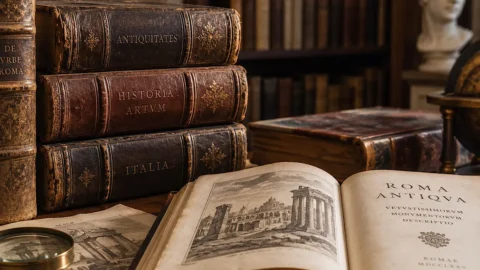
The project also includes a historical section in which the roots of the profound fascination exerted on the philosophy by are explored figures of the hermit and his places of retreat, with a particular focus on the legend of the father of the Church St. Jerome (347 - 419), who went down in history for having led an anchorite's life in the desert of Syria and having translated the Bible into Latin. Renaissance paintings and prints dedicated to the iconography of the saint are exhibited in the room that houses a Renaissance study, inside which rare editions of works by Heidegger and Wittgenstein are presented, while the site-specific installation Hutopia (2018) is set up on its external walls ), created by the Scottish artist and poet Alec Finlay.