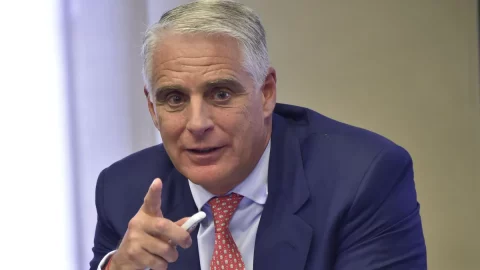
“Given the ongoing uncertainty generated by the golden power, For Unicredit and its shareholders, we have decided to terminate this transaction and move forward." To leave no room for doubt, these are the first words spoken by the bank's CEO. Andrea Orcell, opening the conference call on the second quarter 2025 accounts, closed with record results and upwardly revised guidance. “Even though our decision was difficult, It's absolutely the right choice for all our stakeholders,” he added. And the market seems to agree, considering that Unicredit shares are up 4,46% on the stock exchange and BPM shares are trading in the red by almost 2%.
In an interview published this morning on Cnbc, the manager explained: “'We have drawn a line on this transaction, which to tell the truth it had become a burden to us”, also because “we have accelerated much more than them and the value "between the two institutions" had changed, but, above all, given the golden power situation, there was no other choice", he declared, then taking a dig at the top management of Banco Bpm, guilty according to Unicredit of having invoked the application of special powers, preventing Unicredit from communicating with its shareholders in a "normal" way. "In Italy we are generating in one quarter the same net profit that Banco Bpm generates in one year. And we are accelerating, they are decelerating,” Orcel said.
The the 30-day suspension established by Consob on Wednesday it wouldn't have changed anything, the CEO explained to Mf, "because the times of the TAR, the times of the European Union go beyond. The Is the game over for good? “Nothing is ever over. We evaluate everything and look at everything, but I would say that the situation should change a lot, because we can do something different,” Orcel told Mf.
During the call with analysts, the banker then new M&A operations denied In short: "We are not required to engage in M&A; our duty is to create value. We monitor opportunities in the countries where we operate: if an M&A opportunity arises in the future, which is in the best interests of our shareholders and UniCredit, we will consider it," but "at this time we don't see any," he assured.
Orcel: "Commerzbank has more value than Italy. Criticism of Merz? Ask him."
During the conference call Orcel also spoke about the other big game that Unicredit is playing: the one on Commerzbank. “We said that at this point we are just investors, and indeed we are, and we continue to say that there is nothing else on the table. We don't rule out the possibility, but for now there is nothing on the table," said the UniCredit CEO.
“If you ask me if there is value to be created” in Commerzbank, added the manager, “I firmly believe that there is a lot of value to create, significantly superior to what could have been created in Italy"This is an agreement that has been reviewed, proposed, and considered several times over the last decade," he emphasized. According to Orcel, it would be "good for Germany and for Europe, which needs a stronger bank to finance investment and support growth. I think it would be good for the Banking Union., but this is my opinion and to date we have no dialogue on this topic. We have nothing on the table. I know everyone is commenting on the M&A, but there is nothing to comment on because we have nothing on the table nor have we ever discussed it, because the other party is not ready to discuss it and so we respect the fact that we remain investors. We are very pleased to benefit from a 20% return on investment.”
UniCredit's CEO also emphasized that "what we do with Commerzbank and Alpha is not correlated at all with BPM, zero. There is no impact from the withdrawal of the takeover bid. There is no intention, at this time, to do anything other than consolidate our position in these two banks." As for the recent criticisms from German Chancellor Friedrich Merz, who sees risks for German financial stability in the possible M&A, speaking with the Cnbc Orcel does not comment: “You have to ask him, Because I don't have an answer. The two banks together would have a market share of less than 10%, which is why the German antitrust authority gave us the green light. So I see no reason to be concerned; in fact, this operation would create a very strong competitor. Germany and Europe need a stronger bank, because the system is very fragmented. So, I only see positive aspects".
Orcel: "It's not a good thing for Europe that M&A deals are influenced by politics."
After having spoken in detail about Banco Bpm and Commerzbank, Andrea Orcel also referred to the politics. In Italy, in fact, the operation on Piazza Meda was strongly opposed by the Meloni Government and especially by Economy Minister Giancarlo Giorgetti, who decided to exercise their golden power, citing "national security" despite the offer involving two Italian banks. Not surprisingly, the government's intervention was challenged by the EU Commission, which sent a highly critical letter to which Italy will have to respond in early August, and by a decision by the Regional Administrative Court (TAR), which partially overturned the Prime Ministerial Decree on special powers.
“With the normal M&A process significantly influenced by political action – and it can be observed in Spain and Italy – transactions are influenced and the the result is uncertainty. And situations like the one we are experiencing today arise,” the manager said. “I’m not saying it’s right or wrong,” he continued. “I’m just saying it’s a fact.” A “fact,” which could change the very dynamics of M&A, Orcel emphasizes, because “instead of discussing with one’s own shareholders and the bidder’s shareholders on the merits, on value creation, on strategy, the discussion is completely hijacked and the process takes place through political intervention“As someone who has lived in the UK and the US and has a certain point of view, I don't think this is a good development,” the banker concluded.