In the 2025 Italy's electricity demand stood at 311,3 TWh, a level substantially in line with that of 2024. Behind this apparent stability, however, there is an electrical system that is changing its skin. According to the data released by TernaThe national grid experienced a two-speed year. An initial phase was characterized by declining consumption, followed by a second phase of recovery, driven in particular by the recovery in industrial demand.
Le renewables covered 41% of total demand, a slight decrease compared to 42% the previous year. This figure reflects two opposing dynamics: the return of hydroelectric production on more ordinary levels after the exceptional hydraulicity of 2024 and, at the same time, theunprecedented photovoltaic exploit.
Record-breaking photovoltaic, renewables exceeding targets
2025 marks a new historic record for solar. The photovoltaic production reached 44,3 TWh, with a growth of 25,1% on an annual basis. The peak came in June, when generation reached 5,7 TWh, driven by both increased installed capacity and greater solar radiation. This is the clearest sign of a transition that is progressing, despite the complexities.
Overall, the renewables show a complex pictureHydroelectric power returned to values closer to the historical average, recording a contraction of 21,2%, while wind power recorded a more modest reduction of 3,3%. Geothermal energy remained essentially stable.
In this context, stand-alone accumulations have confirmed an increasing role, with production reaching 1,5 TWh, supporting the integration of non-programmable sources.
Installed capacity: targets exceeded in the Suitable Areas decree
On the infrastructure front2025 represents a turning point. The overall increase in renewable capacity amounted to 7.191 MW. As of December 31, installed capacity in Italy reached 83.529 MW, of which 43.513 MW was solar and 13.629 MW was wind. These figures exceed the target set for the 2021-2025 five-year period by 1.605 MW, as set by the Suitable Areas Decree.
The the accumulations They show a significant acceleration. Over the course of the year, nominal operating capacity increased by 1.743 MW, with a growing contribution from large-scale plants. Overall, active installations exceeded 884 units, for a capacity of 17.920 MWh. The utility-scale segment, supported by dedicated market mechanisms, made the biggest difference, while small-scale domestic storage systems slowed, partly due to the reduction in tax incentives.
Industry and territories: signs of selective recovery
Il industrial consumption picture confirms a gradual recovery. TheImcei index, which measures the consumption of approximately one thousand energy-intensive businesses, closed 2025 with a slight overall decline of 0,7%, but with a marked improvement in the second half of the year. The steel, mechanical, cement, and food sectors performed well, while sectors such as chemicals, paper, and ceramics remained struggling.
From a regional perspective, electricity demand shows differentiated trends, with a slight increase in the North and a more marked decline in the Center and South.
December accelerates, but renewables decline
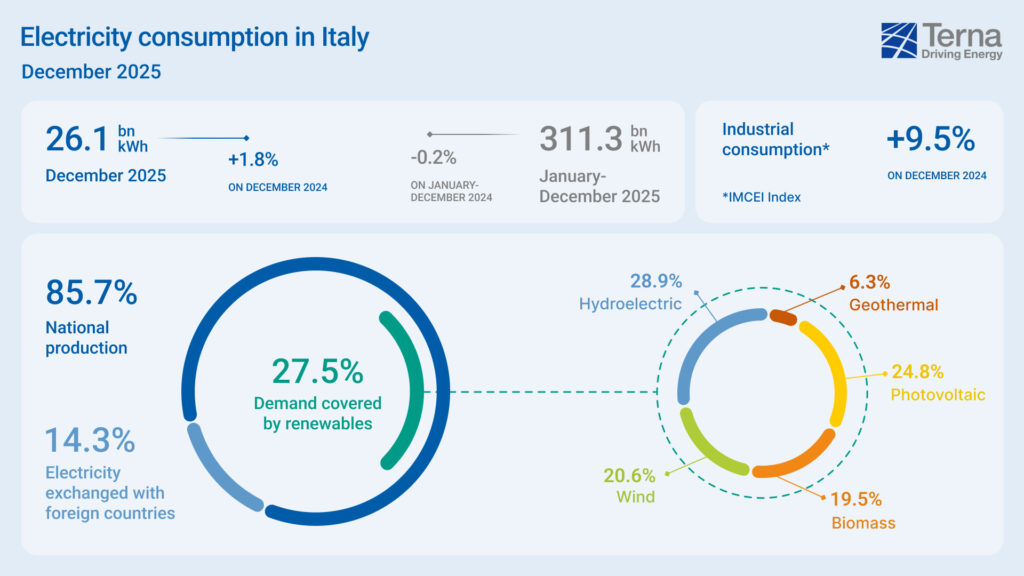
Il month of December marked the highest demand value since 2021, with 26,1 TWh and a 1,8% annual growth rate, rising to 2,6% excluding calendar and temperature effects. Domestic production increased by 5,5%, driven primarily by thermoelectric power, while the contribution from renewables decreased to 27,5% of monthly demand, well below the December 2024 figure. The decline in wind and hydroelectric power significantly impacted this result.
ESG: Terna at the top of international sustainability
Alongside the operational numbers, the 2025 Terna strengthens its sustainability profile. The international agency Standard Ethics ha Corporate Rating “EE+” confirmed, placing the group in the highest "Sustainable" category and recognizing its contribution to the energy and digital transition objectives. This assessment also recognizes the alignment of the 2024-2028 Industrial Plan with the European Taxonomy criteria and the commitment to long-term climate targets.
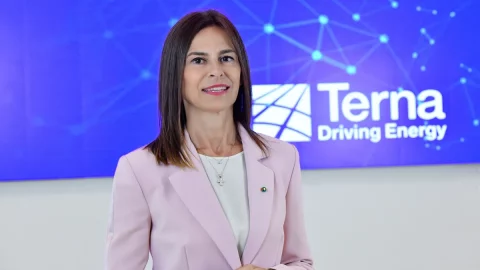
The Standard Ethics assessment is complemented by those of ISS ESG, which maintains Terna's "Prime" status with a B+ rating, and CDP, which places the group in the "Leadership" category for combating climate change. These recognitions confirm the centrality of ESG governance and climate risk management in the business model of the company led by Giuseppina Di Foggia.