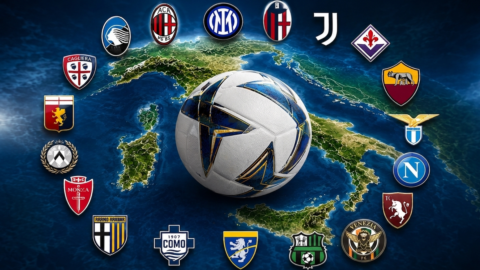
In the 2025 Italian tennis beats football on the economic front: for the first time the Spring tennis exceeds 230 millionof euros in revenues, detaching the Figs, whose balance sheet stops shortly above 200 million, penalized by the absence of major international events. In 2024, the FITP had already reached nearly 209 million, barely challenging football, but this year the gap has widened further, thanks to the extraordinary season of Italian tennis players and the lack of major football events. forecasts for 2026 indicate a further growth, with Fitp's revenues poised to exceed 250 million.
Sporting triumphs that have driven the growth of Italian tennis
In 2025 Jannik Sinner He dominated the scene by winning the Australian Open, Wimbledon, the ATP 500 China Open, the ATP 500 Vienna, the Paris Masters 1000 and the ATP Finals in Turin. Other male protagonists are Flavio Cobolli, winner of the ATP 250 Bucharest and ATP 500 Hamburg, and Luciano Darderi, winner of the ATP 250 tournaments in Marrakech, Bastad and Umag.
Among women, Jasmin Paolini she lifted the trophy at the Italian Internationals, while in the women's doubles with Sara Errani They dominated at the WTA 1000 Qatar Open, the Italian Open, the China Open, and Roland Garros, winning their first Grand Slam together. In men's doubles, Simone Bolelli and Andrea Vavassori they won the ATP 250 Adelaide, the ATP 500 Rotterdam, the ATP 500 Hamburg and the ATP 500 Washington, while in the mixed doubles Sara Errani and Andrea Vavassori They won at Indian Wells, Roland Garros and the US Open.
Italy was the only country with representatives in all categories of Finals in Turin, and the victories in Davis Cup and the Billie Jean King Cup have further strengthened the appeal of the blue movement.
Read EVEN How much does Sinner play? A demonstration against Alcaraz before the Australian Open.
Record numbers and growing economic impact
Sporting success translates into USEFULL Extraordinary: since 2021, the value of FITP's production has more than doubled, and compared to twenty years ago, the increase is almost fivefold. Today, the tennis and padel sector generates over 8 billion euros a year, considering practitioners, events and local related activities.
Tennis is emerging as a concrete alternative to football also in terms of participation: in Italy there are approximately 6,2 million practitioners, close to the 6,5 million of football, and 1,2 million members, with an increase of over 200% compared to 2020. There are 4.465 affiliated clubs, and tennis and padel schools number over 2.500, with approximately 15 coaches and more than 10 match officials. According to Nielsen, racket sports involve approximately 20 million enthusiasts, more than volleyball, athletics, swimming, and basketball, and only slightly less than soccer (21,6 million).
The transformation of the Fitp and the impact of large-scale demonstrations
Much of the success comes from the managerial turnaround led by Angelo Binaghi: a reform of federal governance and an increasingly business-oriented management model. Italian International in Rome, from the 2000s to today, have gone from a declining tournament to a global benchmark event, with an estimated economic impact of 900 million euros in two weeks, over 400,000 spectators and 35 million in direct revenue in 2025, marking a 22% increase compared to the previous year.
The Internationals were joined by the ATP Finals in Turin and, from 2025, the Davis Cup Final 8 in Bologna, which alone generated €144 million. The ATP Finals attracted nearly 230 spectators, generating a total impact of €591 million and tax revenues of nearly €100 million, with a public contribution of €13,7 million. Overall, over 70% of the federation's revenue comes from major international events, which generated approximately €157 million in 2025, and are expected to exceed €170 million in 2025.
Management efficiency and reinvestment in Italian tennis
Fitp has been able to combine sporting results and economic sustainabilityI Costs Operating revenues in 2025 will remain below €16 million, with over 80% of production value reinvested in sports development. Expenditure on sporting activities, including international and national events, prizes, training, and contributions to clubs, will exceed €200 million, consolidating an efficient and replicable model.
A comparison with the FIGC highlights a different approach: the Italian football federation recorded €81 million in public revenue in 2024, primarily from television rights and sponsorships, while the FITP built its leadership on events, spectators, and local businesses, demonstrating the sustainability of a system based on direct participation and the economic value generated by tournaments.
2026 Outlook: Italian Tennis Looks Beyond
Il overtaking of the Fitp on football it no longer appears to be an isolated episodeThe numbers indicate a structural shift in the economic balance of Italian sport. By 2026, the federation expects to exceed €250 million in production value, while for the Italian Football Federation (FIGC), a return to the North American World Cup is essential to regain ground. With the expansion of major international tournaments, a growing number of players, and efficient management, the FITP confirms its position as a key player in a constantly growing sector, destined to leave a lasting impact on Italian sport and the economy.