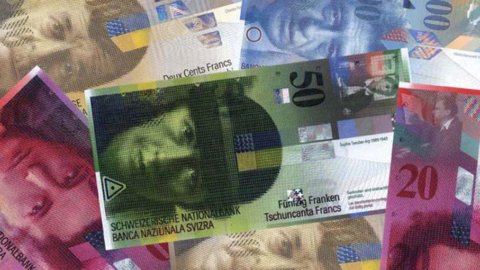
Currency revolution in Switzerland, where the National Bank has decided to cancel the minimum threshold imposed by law on the euro-franc exchange rate (1,20). Not only that: the central bank also further cut the reference rates on deposits (already at negative levels), bringing them to -0,75%.
The Swiss institution explains that the decision to free the franc from the euro was taken following the recent heavy falls of the community currency against the US dollar. Indeed, the minimum ratio implied a depreciation of the franc against the dollar which was not considered justified. As for the cut in interest rates, it was decided to prevent the expected appreciation of the franc from ending up creating unwanted monetary tightening. The central bank then specified that "it will remain active on the markets if necessary".
Meanwhile, on the currency market, the euro-franc exchange rate collapsed to a new all-time low of 0,8422, much lower than the record of 1.0451 reached on August 10, 2011, before the Swiss National Bank established the threshold it had just abandoned. Previously the euro had fluctuated well above these values, at around 1,6 francs in 1999 and at an all-time high of 1,6792 in October 2007. Today, late in the morning, the Community currency recovers part of the fall, returning to 1,0412 francs.
Meanwhile, the Swiss currency also shot to a 30-year high against the Japanese yen, reaching 138, its highest level since 1980, while the euro fell to its lowest level since November 2003 against the dollar, at 1,1571. but then recovering part of the fall to 1,1692.
On the stock side, the Zurich Stock Exchange slumped by 7%, to 8.560 points. Giants like Richemont and Holcim record falls of the order of 10%, Zurich drops by 6%, Nestlé loses more than 4%.
Finally, just today, Geneva should officially sign with Italy the tax agreement, which will be fundamental above all for the possibility of applying the voluntary disclosure on the sums illegally held by Italian citizens in Switzerland.