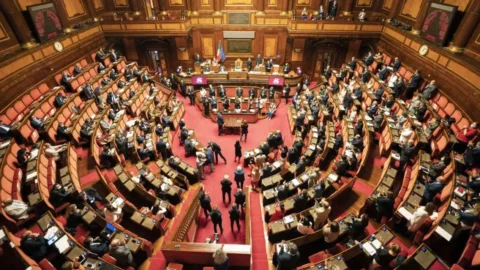
Justice: the reform that introduces the separation of careers of judiciary – “dream” that Silvio Berlusconi shared with Niccolò Ghedini – has been definitively approved by the chamber of Senate on the day the government is grappling with The Court of Auditors' rejection of the Strait of Messina BridgeThe constitutional bill had 112 votes in favor, 59 against and 9 abstentions. The vote is the fourth and final parliamentary step, as required by the Constitution. Before the vote in Palazzo Madama, President Ignazio La Russa ordered a quorum to be ascertained.
Career separation: the referendum in the spring
Already announced recourse to a confirmatory referendum (possible given that the second deliberations of the two houses of Parliament did not register two-thirds of yes votes). The referendum should take place between March and AprilThere has been much political controversy over the reform, which is accused of violating the Constitution. The "No Committee" is up in arms in the referendum.
The provision establishes "rules regarding the jurisdictional system and the establishment of the disciplinary court" and amends Title IV of the Constitution foreseeing the separation of careers between prosecuting and judging magistrates. Therefore, the establishment of is foreseen two distinct CSMs: one for the prosecuting magistracy and one for the judiciary, both chaired by the Head of State. For the composition of these two new self-governing bodies, in addition to the ex officio participants, a drawing mechanismDisciplinary jurisdiction over both adjudicating and prosecuting magistrates is entrusted to a High Court, with the possibility of two levels of appeal before it. Transitional provisions are then established.
Career separation: what's new in the reform?
Two CSMs: are expected two distinct organs of self-government, the Superior Council of the Judiciary and the Superior Council of the Prosecuting Judiciary.
Composition and drawing of the two CSMs: The presidency of both CSMs is attributed to the President of the Republic, while the First President of the Court of Cassation and the Attorney General of the Court of Cassation are ex officio members of the Superior Council of the Judiciary and the Superior Council of the Prosecuting Judiciary, respectively. The other members of each of the CSMs are: drawn by lot, for one third from a list of professors and lawyers compiled by the Parliament in joint session and, for the remaining two thirds, respectively, from among the judging magistrates and the prosecuting magistrates.
The vice-presidents of each body are elected from among the members drawn by lot from the list compiled by Parliament. Members selected by lot serve a four-year term and are ineligible to participate in the subsequent draw. The two CSMs will no longer have jurisdiction over disciplinary actions, power currently vested in a special section within the CSM. The two CSMs will have jurisdiction over "hiring, assignments, transfers, professional evaluations, and assignments of functions to magistrates."
The High Disciplinary Court is born: Another new development concerns the establishment of the High Disciplinary Court, which has disciplinary jurisdiction over ordinary magistrates, both judges and prosecutors. The body is composed of 15 judges selected as follows: three members appointed by the President of the Republic; three members drawn by lot from a list compiled by Parliament in joint session; six members drawn by lot from among the judges who meet specific requirements; and three members drawn by lot from among the prosecutors who meet specific requirements. The president of the High Court must be selected from among the members appointed by the President. President of the Republic and those drawn by lot from the list compiled by Parliament.
The High Court's rulings can be appealed to the High Court itself, which has a different composition than the first instance. High Court judges hold office for four years. cannot be renewed and it's incompatible with that of member of the Parliament, of the European Parliament, of a Regional Council and of the Government, with the practice of the profession of lawyer and with any other position and office indicated by law.