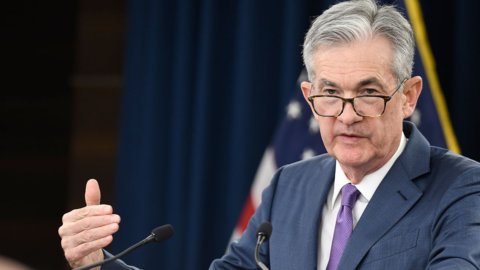
Between Donald Trump e Jerome Powell It's open warfare. For months the US president has continued to criticize the actions of the governor of the Federal Reserve, going so far as to openly insult him for not having yet cut interest rates as he would like. On Wednesday, however, the White House tenant went further, leaking and subsequently denying the intention to fire Powell. A piece of news that immediately sent financial markets into a tailspin. From the dollar to T-Bonds to the stock markets, all hell broke loose in a matter of minutes. So much so that many hypothesize that it was a test And that it was precisely the abrupt reaction of national and international finance that pushed Trump to take yet another step back, waiting for a more propitious opportunity to reach the real showdown. But will it really happen? Trump can really fire Powell, Abdicating the Fed's independence? These are the questions everyone continues to ask. What's the answer? Neither.
Why Trump is so angry with Powell
He applied very heavy pressure, attacked him repeatedly, insulted him by calling him “Stupid Jay”, he even gave him a nickname: “Mr. Too Late", "The Lord is too late." How did Powell respond? By ignoring him., which – as is well known – he doesn't like at all. The war that Donald Trump has waged against Jerome Powell, whom he himself appointed at the end of 2017, during his first term, has been going on for months now. The reason is simple: The US president wants the Fed to cut rates interest rates. "We should have rates 2,5 points lower, we would pay much less in debt," he said. A debt that Trump is also contributing to with his policies, from tariffs to the controversial "Big Beautiful Bill." "The ECB has cut rates nine times," he thundered last month (the Eurotower has actually cut rates eight times, ed.), drawing a comparison with European monetary policy. But Powell resists, and last June 18th, it kept the interest rate at 4,25%–4,50% for the fourth consecutive meeting, awaiting greater clarity on the outlook for inflation and economic activity. Markets, which previously expected four cuts in 2025, are now predicting two, one in September and the other in December. And that's not even a given. Very It will depend on the effect of tariffs. Last week, Chicago Federal Reserve President Austan Goolsbee said that Trump's new tariffs (30% on the EU, 35% on Canada, and 50% on Brazil) had further clouded the inflation outlook and put the central bank at a disadvantage when it comes to cutting rates.
Trump threatens to fire Powell, then denies it: what happened yesterday
The bomb was dropped by Bloomberg who, citing sources within the White House, revealed in the late afternoon in Italy on Wednesday that, during a confidential meeting, Trump had said that He will “probably” fire Powell “soon.” Then came the cbs, according to which the US president would have asked Republican parliamentarians for an opinion on the possibility of torpedoing the president of the central bank.
Within minutes, the markets went into panic, Concerned about the Fed's independence: the dollar fell by more than 1%, the S&P 500 and the Nasdaq began to decline, while long-term Treasury yields soared. Less than twenty-four hours earlier, JP Morgan's CEO, Jamie Dimon had issued a warning clear: “The independence of the Fed is absolutely fundamental… Playing with the Fed can often have negative consequences, the exact opposite of what is hoped for,” the top manager added during a conference call with analysts.
No sooner said than done. The market reaction forced Trump to publicly deny it: “The news about Powell's firing are false,” the US president stated, before later adding: “I'm not ruling anything out, but I think it is highly unlikely, unless he has to go for fraud.” A not random accusation given that it would be one of the few reasons why Powell could really be kicked out at the White House's behest.
Can Trump really fire Powell?
The short answer is: “It's very difficult.”, so much so that it has never been done in over 110 years of history. But someone tried. It was the president Lyndon Johnson, who in 1965 attempted to oust then-Governor William McChesney Martin. Even then, the White House disagreed with the Fed's then-contractionary monetary policy. How did it end? Johnson he gave up his intent as his lawyers advised him against proceeding.
The law that created and regulates the operation of the Federal Reserve dates back to 1913 and provides that the governors of the central bank can be removed from their office only for “just cause”. And, to be clear: under no circumstances can disagreeing with the Fed's monetary policy represent a "just cause." "Just cause" means fraud, misconduct or incompetence manifest in carrying out his role. And here we return to Trump's words yesterday. "Unless he has to go because of fraud," he pointed out, not surprisingly.
Renovation costs: the White House's pretext
The reference is to the harsh criticism from the White House regarding the overcoming of the costs in the renovation The $2,5 billion renovation of the Federal Reserve's historic Washington headquarters, following which Powell himself instructed his inspector general to examine the building expansion, which has come under scrutiny by the US administration. "We have a real problem of oversight and overspending," said Kevin Hassett, director of the National Economic Council. The inspector general serves the Fed and the Consumer Financial Protection Bureau and is responsible for investigating fraud, waste, and abuse. This is what Trump means when he speaks of removal for “fraud”In short, excessive restructuring costs could be Trump's ploy to fire Powell. A ploy that, according to Democratic Senator Elizabeth Warren (and others), is merely an excuse: "It's a clear pretext," she stated.
The possible legal battle and its consequences on the markets
If Trump continues with his intent, he will most likely face a tough legal battlePowell has in fact repeatedly said that he does not want to leave his mandate early, which expires on May 15, 2026, in less than a year. As he explains: Bloomberg The dismissal would be effective immediately, but Powell could immediately sue, seeking an injunction for unjustified dismissal and asking for reinstatement pending a final ruling, which could take months.
If Powell's injunction request is denied, his dismissal would remain in effect and the vice-chairman of the Fed (Philip Jefferson, Biden's nominee in 2022) would assume the office of president. Conversely, if the injunction is granted, Powell would remain in office while the case proceeds. Either side could appeal, at which point the matter could go directly before the Supreme Court, of a clearly republican nature, it must be remembered, which would have the final word.
In the meantime we will have to see what it will be the mood of the financial markets once the supreme principle of the independence of the Federal Reserve has been undermined. The risk of a sudden and lasting negative reaction It's very high. Perhaps Trump would do well to heed the advice of a veteran financial wolf like Dimon: there really is no point in “playing the Fed.”