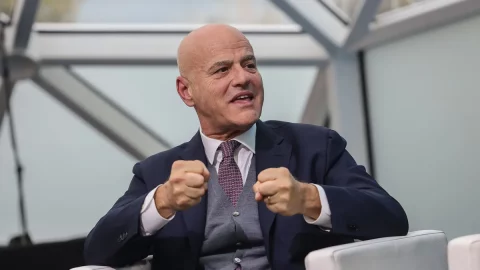
Eni changes pace in Venezuela and takes the keys to one of the largest heavy crude oil deposits in the worldIn the presence of the President-elect of the Bolivarian Republic, Delcy Rodriguez, and the US Secretary of Energy Chris Wright, Eni and PDVSA signed today in Caracas the “Contract for Productive Participation in Hydrocarbons” (CPPH) for the development of Junín-5, in the Orinoco Belt.
An agreement that is not only industrial, but it has a clear political and financial weight: the signing took place during Wright's official visit and was presented as a fundamental step in the relaunch of the Venezuelan energy sector.
Goodbye mixed enterprise, let's go to CPPH
The agreement formalizes the process started with the Head of Terms of 28 April 2026 and marks the exit from the old model of the mixed company PetroJunín – 40% Eni, 60% PDVSA – to transition to the new contractual regime introduced by the Organic Law on Hydrocarbons approved in January 2026.
The CPPH has a duration of 25 years, with the possibility of extension, and grants Eni the exclusive operatorship. In financial terms, this is the key point: Eni will have full responsibility for the technical, financial, and commercial management of the field. No longer a minority partner in a state-owned joint venture, it will become the operator with control over the capex, development schedule, and marketing. The signing was attended by the Venezuelan Minister of Hydrocarbons Paula Henao and PDVSA CEO Héctor Obregón, while Eni was represented by CEO Claudio Descalzi.
The 35 billion barrel super-giant
Junín-5 is a giant onshore heavy oil field. The numbers explain its rerating potential: 35 billion barrels of certified oil in place, compared to current production of just 12 barrels per day. This is a huge gap between reserves and production that, if filled, could make Eni one of the main drivers of Venezuela's recovery.
For Piazza Affari, the transaction opens a growth lever with a low entry cost on already certified reserves, but with high capital intensity in the coming years. The CPPH model, more streamlined than the mixed company, should ensure Eni a quicker recovery of its investments and a greater share of production.
"This agreement represents a new pillar for the relaunch of the oil and gas sector in the country, at a time when energy security, based on an abundance of resources and diversification, is vital for global equilibrium." commented Descalzi“The operatorship of Junin-5 is recognition of our ability to quickly and efficiently realize complex projects.”
The political green light: the Washington-Caracas axis
Chris Wright's presence is not a detail. Report the US green light for the return of international operators to Venezuela After years of sanctions and underinvestment, this represents a competitive advantage for Eni, which unlike many majors has never left the country. The Junín-5 agreement builds on a presence established since 1998. Eni holds six mining licenses, including offshore—the Gulf of Venezuela and the Gulf of Paria—and onshore Orinoco.
The productive heart remains gasThrough Cardon IV, a 50/50 partnership between Eni and Repsol, it operates Perla, the largest offshore gas field discovered in Latin America. Cardon IV has just signed a Sustainability Agreement to relaunch production, increase volumes for the domestic market, and establish the conditions for future exports.
Added to this are the 26% stake in PetroSucre (74% PDVSA) which operates the Corocoro offshore oil field and the share in Supermetanol for methanol. In 2025, Eni produced 64 boe per day in Venezuela., almost all from Perla, which alone covers approximately 35% of the gas consumed in the country.
With Junín-5, the center of gravity shifts decidedly towards heavy oil, with an asset that, if developed, could be worth several hundred thousand barrels per day and put Venezuela back on the map of large upstream investments.