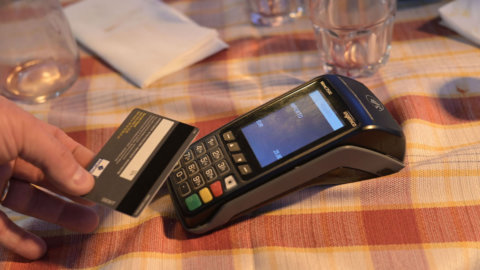
The United States dominates, unchallenged and perhaps unchallengeable, the payments industry. This was certified by the Mediobanca Research Area in the first edition of the Paytech report which analyzes the financial statements for the three-year period 2018-2020 and the first nine months of 2021 of the 25 international PayTechs with revenues exceeding one billion euros.
THE BIG FIVE AND THE WORLD RANKING
Five American companies – America Express, Visa, Paypal, Mastercard and Fiserv – account for 59% of international paytech revenues. US dominance expands to 88% of the total if we consider the sum of the revenues of the 15 US-based companies. Followed by the European and Brazilian groups which determine, respectively, 10% and 2% of the world turnover which last year reached 140 billion dollars.
In the ranking drawn up by the Mediobanca research centre, first place is firmly occupied by Visa, with 8.900 billion dollars in payment volumes, 3,6 billion cards in circulation and 205 billion total transactions. In Europe, according to 2020 revenues, MasterCard Europe (4,4 billion) and Visa Europe (3,1 billion) are the main groups, but the M&A has changed the cards on the table, with Worldline which, by acquiring Ingenico, would be first in pro forma revenues with 4,8 billion euros. Nexi grinds positions, moving from eighth to fourth position with a turnover of 2,9 billion euros, achieved thanks to the acquisition of Nets and Sia. The Italian group is also the leader for merchant acquirers, with 11,7% of the market.
"In general, the pandemic has had a negative impact on the financial statements of these companies which, however, have shown good resilience, managing to contain the drop in aggregate turnover (-2% on 2019)", explains Mediobanca, according to whom due to Open Banking and the digitization of the economy, the global scenario of the payments industry has radically changed and now sees the banking giants competing with new technological platforms, challenger banks and BigTechs.
CASHLESS BOOM
The data relating to the is relevant cashless transactions which in 2020 reached an all-time high, reaching 785 billion (compared to 389 billion in 2014). "However, their growth went from +16,5% in 2018/19 to +7,8% in 2019/20, affected by the effects of the pandemic", underlines the study. As for 2021, Mediobanca's estimate, which cites the Capgemini World Payments Report 2021, is over 920 billion transactions worldwide: 320 billion of these relate to Asia. From a geographical point of view, Italy is 26th in Europe for digital payments per capita but the strong endowment of Pos terminals and the growth trend of payments via mobile are indicators of the possibility of exploiting the great growth spaces of the sector in our country , explains the report.
Positive signals also come from the accounts of the first months of 9 2021, a period in which the total revenues of PayTechs amounted to 110,6 billion (+14,4% over the first nine months of 2020, of which +14,5% from the US and +11,6% from Europe), while the operating result improved by 17%, with the European groups accelerating (+24,1%).
PAYTECH IN ITALY
Last year, in Italy, the payments market recorded a contraction of 8,8% to 245,8 billion. Traditional retail is down which, despite representing 73% with 180,5 billion, has recorded an average annual decline of -2018% since 6,7. On the other hand, digital payments are increasing, growing at an average rate of +7,1% in 2018-2020 to reach a total value of 40 billion euros in 2020, thanks also to e-commerce. In total, at the end of 2020 the stock of electronic money in circulation in Italy amounted to 11,4 billion (+28,1% on 2019).
Despite the strong expansion of digital payments, in our country the share of cash on transactions remains high (in 2019 equal to 58% in value and 83% in volume), higher than the European average (48% and 73% respectively). “All this despite the false myth that electronic payments are more onerous than cash, which instead conceal latent costs related to production, transport and management, which the Bank of Italy estimates at 7,4 billion a year (0,45 % of GDP) and which affect corporate profitability and the competitiveness of our country, explains Mediobanca.