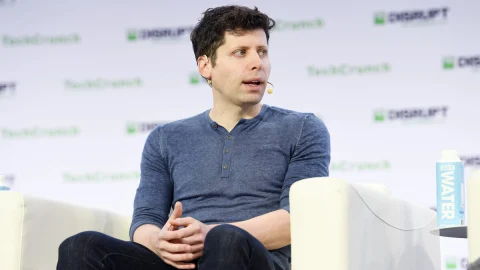
OpenAI, Sam Altman's brainchild that gave birth to ChatGPT, enters history. The company's valuation has reached 500 billion dollars, surpassing Elon Musk's SpaceX (stopped at 400 billion) and thus becoming the most valuable startup in the world.
The finish line was achieved through a $6,6 billion transaction, the result of shares sold by current and former employees to a select group of investors: Thrive Capital, SoftBank, Dragoneer, MGX Abu Dhabi, and T. Rowe Price. This transaction boosted the company's valuation well above the $300 billion set in its last financing round, which took place earlier this year.
But it didn't end there. OpenAI has entered into a strategic partnership with Samsung Electronics, which will support the company in the "Stargate" project, providing advanced semiconductors to support an estimated memory demand of up to 900.000 DRAM wafers per month. Alongside the Korean giant there will also be SK Hynix, ready to guarantee crucial supplies for data centers and artificial intelligence model training.
And the market is appreciating. OpenAI's boom and its new partnership with chip giants have pushed tech stocks higher on Wall Street and in Asia, further cementing artificial intelligence's role as the engine of a new wave of stock market growth.
OpenAI: Big Tech Numbers, But Profits Still A Long Way Off
The rush to valorize is fueled by impressive numbers. But all that glitters is not gold. In the first half of 2025 alone, OpenAI generated approximately $4,3 billion in revenue, more than the turnover achieved in the whole of 2024. But behind the records there is also the fragility typical of hyper-growth startups. And, in fact, in the same period, the company burned 2,5 billion, with research and development expenses exceeding 6,7 billion.
The company still has substantial reserves, with approximately $17,5 billion in cash and securities, and aims to close the year with $13 billion in revenue. For analysts, however, the pace at which OpenAI is growing represents a clear signal that despite the lack of profits, the company is perceived as the undisputed leader in the AI race, along with giants like Nvidia.
OpenAi: Between Nonprofits and the Race to Market
It's a pivotal moment for Sam Altman's company. OpenAI is engaged in delicate negotiations with Microsoft to complete the transformation from a non-profit organization to a more traditional for-profit corporation. passage that fuels tensions, also in light of the clash with Elon Musk, co-founder who has now become a fierce critic of the company's governance.
Musk accuses OpenAI of having betrayed the original mission, developing artificial intelligence for the benefit of humanity, in favor of a billion-dollar partnership with Microsoft, which began in 2019.
The race for AI dominance is heating up. And so the talent market is booming. Meta, for example, snatched the founder of Scale AI from OpenAI, Alexandr Wang, to lead a dedicated superintelligence unit, with nine-figure salary packages.
The global race for AI
OpenAI is not only an algorithm laboratory, but also a key player in the global AI infrastructureAgreements with giants like Oracle and SK Hynix, along with the trillion-dollar commitment to building data centers, show that the future of AI depends as much on computing power as on the ability to create increasingly advanced models.
The record rating is therefore also a betting on the role OpenAI will have in the global technology ecosystem on one side a startup still far from profitability, on the other a strategic asset that could define the next phase of the digital economy.
Sora 2: The New Front Between AI and Social Media
In the meantime, Altman has raised the curtain on Sora 2, the new generation of generative video. Not only a technological upgrade, with more realistic images, integrated audio, and more faithful adherence to the laws of physics, but above all a social challenge. The launch also introduced a real app, with TikTok-style content feeds, entirely based on AI videoThe platform introduces features that are sure to spark discussion, including "Cameos," deepfake videos that can be created with the consent of users, who will be required to provide a recording to certify their identity and appearance. Each user will also be able to control their own feed, choosing whether to view relaxing, motivational, or interest-related videos.
Altman admitted the risks, speaking openly about digital bullying and addiction, but emphasized that the goal is to make Sora "a tool that improves users' lives in the long run." It remains to be seen whether it will deliver on its promise of being an ally of digital well-being or whether it will end up becoming yet another tool capable of amplifying addictions and abuse. the line between innovation and responsibility has never been so thin.