" date of May 23 marked the history of the Republic. The Massacre of Capaci, one of the bloodiest manifestations of mafia inhumanity, was an attack of unprecedented ferocity against the freedom and dignity of Italians." With these words the President of the Republic Sergio Mattarella remembered Giovanni Falcone on Legality Day, 34 years after the attack which changed the history of the country.
The head of state's first thoughts went to Falcone, his wife Francesca Morvillo, and the bodyguards Antonio Montinaro, Rocco Dicillo, and Vito Schifani, killed in the explosion on the Palermo-Punta Raisi highway. To them, Mattarella linked "with the same thread of memory" the names of Paolo Borsellino, Emanuela Loi, Agostino Catalano, Walter Eddie Cosina, Vincenzo Li Muli, and Claudio Traina. victims of the same subversive mafia strategy.
For the Quirinale, Capaci was not just a massacre. It was a assault on the state, to freedom and constitutional values. But precisely from that wounda, Mattarella underlined, a collective reaction was born: “May 23rd represented thestart of civil recovery, which is why it has become “Legality Day” for Italians.
The mafia wanted to bend the state, it found a stronger country
The Mafia "wanted to subdue the institutions with violence and blackmail, but faced inflexible responses, suffering irreversible defeats." In Mattarella's words, that response was possible thanks to "courageous and tenacious" men and women of the institutions and the decisive contribution of citizens. The president, however, warned that commitment cannot know pausesIt remains necessary to combat "the gray areas, the indifference, the metamorphoses of the criminal octopus." This is where the memory of Falcone and Borsellino ceases to be merely commemoration and becomes method, public responsibility, and civic education.
“Giovanni Falcone, and with him Paolo Borsellino, taught us: the The mafia will end thanks to strong institutions and effective and coherent counteractions., with an educational commitment that can increase trust in a tomorrow to be built together". For Mattarella, theThe legacy of the two magistrates is "an ethical and civil heritage" of Italian democracy, delivered first and foremost to the new generations.
Falcone, the magistrate who changed the fight against Cosa Nostra
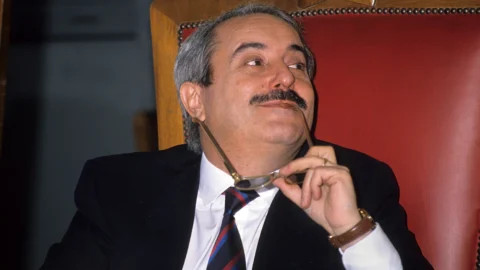
Thirty-four years after Capaci, the The figure of Giovanni Falcone remains central in the history of the fight against the mafiaHis investigations helped reconstruct the military and top-down structure of Cosa Nostra, identify its perpetrators and instigators, and analyze the relationships between crime, power, and the economy. Along with Paolo Borsellino and the team led by Antonino Caponnetto, Falcone was among the protagonists of the maxi-trial, which brought to trial 474 defendants and marked an unprecedented judicial turning point. That investigative method looked at assets, cash flows, and economic interests: follow the money it meant uncovering the mafia's hierarchies, alliances, and deep connections.
The confirmation of the accusation up to the Supreme Court represented ahistoric defeat for the Cosa Nostra leaders. But he also opened the most ferocious phase of the mafia reactionThe murder of Salvo Lima was one of the starkest signs of that period. Then came Capaci, with explosives planted under the highway and the remote control operated by Giovanni Brusca. Fifty-seven days later, the same strategy would strike Paolo Borsellino on Via D'Amelio.
The legacy handed down to young people
In Mattarella's message, the memory of Falcone and Borsellino becomes a commitment that concerns the present and, above all, the future. Their legacy is highlighted as an ethical and civil asset of Italian democracy, to pass on first of all to young people, because the fight against the mafia is not limited to sentences or police operations, but also lives in the formation of a collective conscience.
Capaci was a national tragedy, but it also marked the moment when the fear began to transform into civic awarenessThe Mafia struck to intimidate the state and undermine citizens' trust. It achieved the opposite effect: Falcone's name became a moral frontier for the Republic, a starting point for building legality, memory, and responsibility.