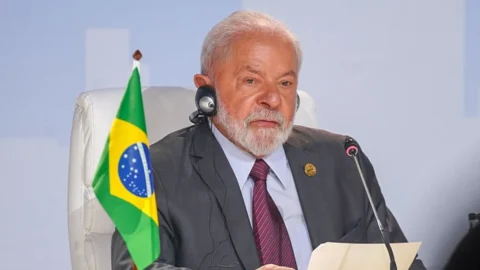
While the winds of war continue to blow in Europe, a leader of the South American world is preparing for a double official visit to Russia and China, of great geopolitical significance. He is the Brazilian president Squid, who landed in Moscow yesterday and will remain in Russia until Saturday, before flying to Beijing early next week. Lula meets Vladimir Putin to talk about business (the two countries had a trade exchange of 2025 billion dollars in the first quarter of 12,4) but above all to try to be more convincing than Donald Trump as a peace mediator in Ukraine.
Lula, peace mission in Russia and China: why
The attempt by the president of Brazil is significant because on the one hand the first economy of South America is allied with Russia and China in the group Brics (and in fact the Chinese president also supports him on the diplomatic strategy for Ukraine Xi Jinping), but it is also a full-fledged part of the Western bloc due to its political, economic and cultural ties. Brazil is in fact a member of the G20 (of which it held the rotating presidency last year, welcoming the leaders in Rio de Janeiro) and at the end of this year it will host COP30 in Belem, in the Amazon. Lula's role can therefore be the trait d'union between the Euro-Atlantic axis, which at most speaks to Putin on the phone and has imposed severe sanctions on Russia, and the BRICS front of which the Kremlin is part and with which Brasilia continues to maintain commercial relations as if nothing had happened.
Lula and the ties between Brazil and Russia
“Brazil wants peace and constant dialogue with Russia,” Ambassador Eduardo Saboia anticipated on the eve of the highly symbolic visit. Ties between Brazil and Russia are solid to the point that Lula's trip was preceded by the mission of first lady Janja da Silva, who in St. Petersburg received the proposal of an honorary degree for her husband from the historic State University, founded in 1724, saying she was "full of pride". The Brazilian president will collect it in the coming days, in the midst of other commitments among which the celebrations for the 80th anniversary of the Soviet victory in the Second World War stand out. Putin has invited 29 world leaders to the event but the only confirmed presence, from the Western world, is precisely that of Lula, while it seems unlikely that anyone from the United States will arrive, although the invitation was duly delivered to the embassy.
Lula and China
Instead, there will be Xi Jinping, who will then receive his South American counterpart in Beijing on May 12 and 13. On that occasion, the BRICS summit scheduled for July will be discussed, which will once again be hosted in Brazil, in Rio de Janeiro. And then business, but not only that. China It is the country to which Portuguese speakers send more than a quarter of all their exports, especially soy, beef, chicken, coffee and much more. In times of tariffs, Beijing is organizing itself to grab the very precious South American raw materials, essential to feed its population of over a billion people and to gain an advantage in the technological challenge with the USA.
Lula, Brazil and “critical” raw materials
In fact, Brazil, and all of Latin America, is a well of food and mineral commodities, including the famous “critical” raw materials which are used for the energy transition. China already draws from it (for example, it already buys three times as many soybeans from South America as it does from the United States) and wants to do so even more to protect itself from trade tariffs or in any case from the hostile attitude of the White House. However, Lula and Xi are preparing to sign strategic agreements that will not only concern trade. While it seems that the United States is doing everything it can to make itself unpopular, China is weaving webs and strengthening its sphere of influence in the world, to ensure that the new generations of the planet not only continue to buy Chinese but replace, why not, the "American dream" with the "Chinese dream".
Is there a world outside the West?
This is why the two leaders will also talk about exchanging knowledge, following up on partnerships which already involve 39 universities in the two countries to spread, for example, the teaching of the Portuguese language in China, or the skills to reduce the digital gap in Brazil, up to the establishment of a Sino-Brazilian Institute of Advanced Engineering to strengthen collaboration on electric cars, which Chinese companies such as Byd they already produce and sell in South America, while in Europe and North America they try to tickle them with duties. There is a world outside the West.