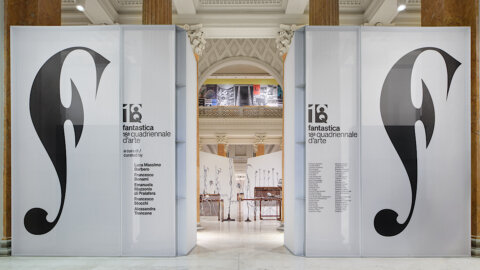
The exhibition displays the works of 54 living artists, born between the 1960s and the end of the 1990s, including 16 under 35, and sees 45 first participations in the Quadriennale, for a total of 187 works distributed over approximately 2000 m2 of exhibition space, with a significant presence of site-specific productions. With a large choral project, Fantastic The exhibition recounts art in Italy in the first twenty-five years of the 21st century through five investigative paths, developed by the curators and distributed throughout the ground-floor spaces of the Palazzo delle Esposizioni. In the My image is what I let represent me: the self-portrait, edited by Luca Massimo BarberoThe central theme is the representation of the self, understood as the ability to choose how to portray oneself or what to be represented by. The inspiration comes not so much from the myth of Narcissus as from Jean Cocteau's Orpheus, where the mirror becomes a threshold between communicating worlds, rather than a simple reflecting object. In Full memory. A room all to yourself., edited by Francesco Bonami, the focus is on the concepts of independence and autonomy, distinctive elements of the artistic generation on display. Each artist maintains their own identity, connected to multiple others, without the need to adhere to groups or trends. The section is inspired by Virginia Woolf's essay A room all to yourself, which becomes both a thematic manifesto and an exhibition solution. Emanuela Mazzonis, with The time of images. Images out of control?, explores the role of photography in contemporary art. Here, photography is no longer a simple representation of reality, but a tool of revelation, constantly evolving towards new and ingenious expressive possibilities. Finally, Francesco Stocchi presents an untitled section, designed to celebrate the creative act. An approach of collective procedural autarchy emerges here, restoring the artist's centrality not only in the creation of the work but also in the design of the exhibition space, conceived to welcome and engage the public. Alessandra Troncone's section, The unfinished body, invites reflection on possible contemporary narratives of the human and non-human body, exploring myth, science, and social transformation through works that offer layered and composite visions. The 18th Quadriennale d'Arte is also enriched by a program of performances, transforming the exhibition into a space of continuous activation and interaction between body, space, and artwork, making the visit an immersive and participatory experience.
The unifying element of the exhibition is the installation designed by BRH+ (Barbara Brondi & Marco Rainò)
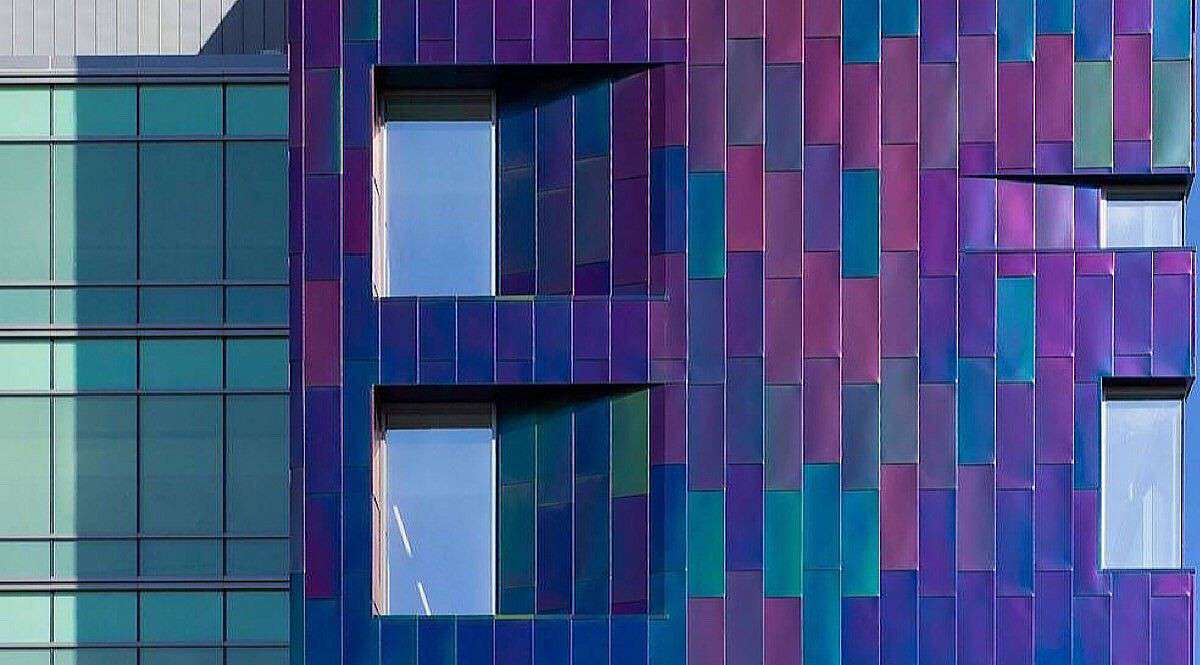
An installation that defines the spaces, accommodates the works, and guides visitors through a system of architectural devices, with curtains designed to connect the five sections rather than separate them. The visual identity, curated by Leonardo Sonnoli and Irene Bacchi's Studio Sonnoli, draws inspiration from the fantastical and surrealist universe, epitomized in the large "F" that serves as the Quadriennale's logo.
Also, on the first floor "The youth and the masters"
In parallel to Fantastic, on the first floor of the Palazzo delle Esposizioni, a historical exhibition project entitled The young and the masters: the 1935 Quadrennial, curated by Walter Guadagnini and produced in collaboration with the Quadriennale Archive Library. The exhibition celebrates the historic Italian art exhibition of the 1930s, an event that marked the Quadriennale's transformation from a periodical event to an institutional body. This year marks the ninetieth anniversary of the second Quadriennale of 1935. The historic exhibition, too, is designed by BRH+, and its visual identity is by Studio Leonardo Sonnoli.
Technical partners and financial commitment
The 18th Quadriennale d'Arte was made possible thanks to a total budget of €2,6 million, 44% of which came from the institution's own funds, 40% from an extraordinary contribution from the Directorate General for Contemporary Creativity of the Ministry of Culture, and 16% from private support. Intesa Sanpaolo confirms its role as Main Partner of the exhibition, in line with the Group's cultural development programmes and with the Culture Project, the hub of the activities of the Galleries of Italy, the bank's four museum branches in Milan, Naples, Turin and Vicenza. Enel è official sponsor of the review. Rome Foundation participate as Cultural partner, as a patron committed to the promotion of contemporary art, supporting in particular the Quadrennial Award and Young Art Award. Main technical partner is Dresswall, creator and creator of the system of veils that connects the various exhibition sections. ILTI Light, part of Nemo Group, is the technical partner for the lighting project of the exhibition.
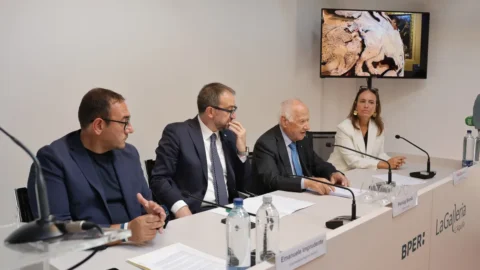
Promoted by the Fondazione La Quadriennale di Roma, with the participation of the Ministry of Culture, the Lazio Region, Rome Capital and the Rome Chamber of Commerce, and organised in collaboration with the Palaexpo Special Company, the exhibition, entitled Fantastic, is curated by Luca Massimo Barbero, Francesco Bonami, Emanuela Mazzonis di Pralafera, Francesco Stocchi and Alessandra Troncone.
The Rome Quadrennial: History and Presidencies
Founded in 1927, the Rome Quadriennale was created with the aim of promoting contemporary Italian art through a major periodic exhibition. The first edition was held in 1931 at the Palazzo delle Esposizioni, with Enrico di San Martino Valperga as president and Cipriano Efisio Oppo as secretary general. Over time, the Quadriennale has chronicled the evolution of Italian art, from the postwar period to Arte Povera, up to more recent experimentations. Transformed into the Fondazione La Quadriennale di Roma in 2004, the institution is co-owned by the Ministry of Culture, the Lazio Region, Rome Capitale, and the Rome Chamber of Commerce. Recent presidents include Umberto Croppi (2019-2023), Luca Beatrice (2024), and the current president, Andrea Lombardinilo (since 2025). Today the Quadriennale is a permanent observatory of contemporary Italian art, and with its 18th edition, “Fantastica,” it continues to explore the multiple creative visions of the 21st century.