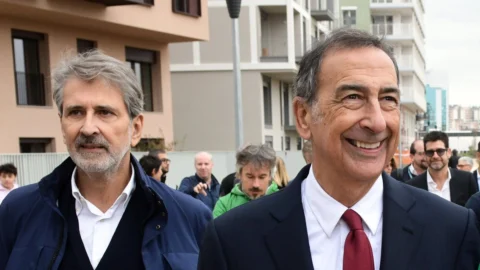
They are six The arrests ininvestigation on 'city planning a Milan decided by gIP Mattia Fiorentini, who did not acknowledge the accusation of undue inducement for the Pirellino affair, an accusation that the prosecutors had contested against the mayor Giuseppe Sala (along with an accusation of forgery) and the architect Stefano BoeriAt the same time the investigating judge ordered house arrest for theformer councilor Giancarlo Tancredi, for the CEO of Coima Manfredi Catella, to Joseph Marinoni e Alessandro Scandurra, respectively president and member of the Landscape commission and for the former manager of J+S Federico Pella, and ordered prison for the entrepreneur Andrea Bezziccheri, owner of Bluestone.
Milan Urban Planning Investigation: Who Are Those Arrested?
Judge Mattia Fiorentini, therefore, says yes to the six arrest warrants put forward by the public prosecutors investigating the alleged system “wild and sprawling speculation” that would have turned Milan upside down. A "victory," however, not a complete one for the prosecutor's office, because the judge himself—in the 400-page justification for the precautionary measures—strongly calls into question one of the charges, the most serious, put forward against Mayor Sala, that relating to the favorable opinion for the Pirelli skyscraper, one of the many skyscrapers in whose shadow the illicit plots allegedly took place. Prison was ordered only for Bezziccheri; house arrest was given to the "king of construction," Catella, former councilor Tancredi, then Marinoni, Scandurra, and the builder Pella. It was the council led by Mayor Giampiero Borghini, in full Tangentopolis, that a councilor, now former after his resignation, but still in office at the time of the arrest request, was not arrested at Palazzo Marino.
The preliminary investigations judge issued the precautionary measure on charges of corruption involving acts contrary to official duties against all the suspects; false statements regarding personal qualifications against Marinoni, Scandurra, and Tancredi; and undue inducement to give or promise benefits to Tancredi, Marinoni, and Catella. However, there is no "serious evidence of guilt" for three alleged corruption incidents against Marinoni, and in particular, for the one involving Mayor Sala, according to the Prosecutor's Office.
Urban planning investigation in Milan: the investigating judge's doubts
The mayor's position is indirectly eased, as is that of architect Boeri. The judge does not question Catella and Boeri's pressure on the Landscape Commission and the mayor, but it is precisely from a legal standpoint that the crime would not stand because Marinoni was not offered "any advantage" by favoring Catella. The judge's premise is that "for the crime of undue inducement to be committed, an undue advantage must be presented to the recipient of the inductive conduct, who is then led to yield to the pressure received in order to gain a personal benefit and is then convinced, thanks to this leverage, to accept the bribery and intentionally produce an unfair advantage, confiscated by the public official or a third party identified by the latter." For the investigating judge, however, Marinoni "yielded to the insistence not because he was tempted by something, much less because he was coerced, but simply because he was unworthy of holding a public office that would have required him to be impartial and impartial." In short, a scathing moral judgment on one of the key figures in the affair, but in this case without criminal implications.
The prosecutors will still have the possibility to continue to explore this hypothesis of crime denied by Fiorentini but it is clear – underlines theAgi – that the judge's arguments might lead them to reflect. Sala also accused of false accusations for having confirmed Marinoni as president of the Landscape Commission. Despite being under investigation for an alleged conflict of interest with the developers whose projects he was supposed to provide favorable and unfavorable opinions on, the judge otherwise fully "embraces" the scenario outlined by the prosecutor.
An urban planning investigation in Milan, according to the investigating judge, reveals a "consolidated system of corruption."
The investigations, the judge writes, "have revealed the existence of a consolidated system of corruption and collusion between public and private interests focused on the figure of the landscape commission" which is defined as "an organization capable of creating a concentration of power and channeling it towards the division of buildable land to the advantage of a small circle of professionals and speculators." The judge characterized the mechanism as follows: "In practice, by bribing President Marinoni, Vice President Oggioni, and individual members of the landscape commission (including Scandurra), composed entirely of professionals operating in the Milan area (who in turn were influenced by the former and subject to pressure from Councilor Tancredi), major private developers were able to obtain advances and special consideration for their applications." The defense now has the possibility to appeal to the Review Court to free their clients, Bezziccheri's lawyers have already made it known that they intend to move in this direction. From what emerges, however, the investigations by magistrates Petruzzella, Filippini and Clerici will not stop even in August: other projects have also ended up in the prosecutors' sights, some of which have been reported in the numerous complaints filed by citizens. Among these, also the stadium di San Siro.