Considered among the most revolutionary of the twentieth century and defined in 1908 as the “painter of light”, Giacomo Balla (Turin, 1871 – Rome, 1958) dedicated his entire life to tireless research on light, colour and movement.
Works, documents and archival materials exhibited in 13 rooms
The exhibition is based on a core collection of works donated by his daughters, Elica and Luce Balla, and enriched with paintings and drawings selected by Maurizio Fagiolo dell'Arco with Elena Gigli. In Parma, across 13 rooms, Giacomo Balla's "universe of light" will be presented thematically and chronologically, retracing the artist's entire career: from Social Realism to Divisionism, from the Futurist period—of which he was a leading figure alongside Marinetti, Boccioni, Carrà, and Russolo—to his later figurative explorations. Archival documents and materials will complete the exhibition, portraying an experimental and visionary genius.
Among the most significant nuclei of the exhibition stands out the cycle of the living
Of the fifteen works conceived by Balla, revealed in 1968 by Maurizio Fagiolo dell'Arco, only four remain, dedicated to the poor and marginalized of the new progressive society, in dialogue with the research of Cesare Lombroso, whom the artist met in Turin. These include The Madwoman, a powerful portrait of a sick woman, and The Sick (or First Electric Cures), along with The Beggar and The Peasant—the latter presented in Parma through a photographic reproduction. The four canvases will be displayed in the order desired by Balla, in the manner of a polyptych.
The search for geometric abstraction
The exhibition dedicates ample space to the relationship between Balla's preparatory drawings and paintings, an essential element of his research. An example of this is the study for Failure (1902 ca.), inspired by children's scribbles on a Roman door, which Enrico Crispolti recognized as a precursor of Dubuffet's 1945 mural lithographs. Among the futurist sketches, one of the two studies for The Rhythms of the Bow (1912) stands out, created in Düsseldorf during the decoration of Grethel Löwenstein's house, and linked to observations on the movement of a violinist's hands. Also from his stay in Germany is a study on the iris, with a self-portrait on the back, later called Iridescent Compenetrations: among the peaks of his production, they mark the transition to a geometric abstraction based on the optical-dynamic decomposition of light, which consecrated Balla as a central figure in the origins of European abstraction. From the cycle of Interventionist demonstrations (1915) is part of the imposing Volume forms of the cry "Long live Italy", at the centre of new radiographic investigations which reveal, beneath the horizontal composition, the vertical silhouette of a woman. According to Elena Gigli, this is a reference to the study for Nude backlit (1908), portrait of his wife Elisa, now known in a private collection.
Between cinema, nature and photography
The final sections of the exhibition present Balla's latest figurative work, still little studied, influenced by photography, cinema, and nature. Among these, the most notable is The queue for the lamb (abacchio) (1942), which portrays the food queues in Rome during the war from the window of his home. Even in this phase, light remains the guiding thread of his research.
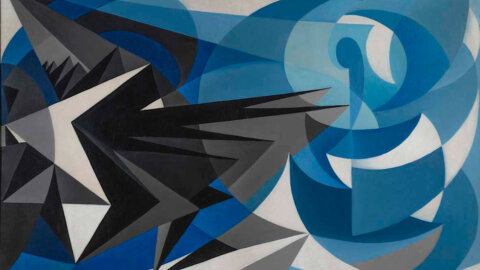
Cover image: Giacomo Balla: Pessimism and Optimism, 1923, oil on canvas, 114,5 x 175,5 cm. Rome, National Gallery of Modern and Contemporary Art. GNAMC/photo by Alessandro Vasari © Giacomo Balla, by SIAE 2025