That in Rai they need more innovation, creativity and the ability to organize original and brilliant programming has now become commonplace, perhaps even ungenerous. Viale Mazzini's strategy to try to stem the bleeding of viewers, who bored by the monotony of broadcasts increasingly decide to migrate to other shores, seems to have been, for some years now, that of relying on the wise and revered lips of the champions of the share .
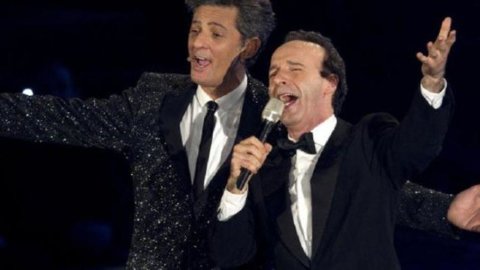
Schema turns out to be the most tested: a big name is found, one of those names that manages to be immune to the passionate tendency, all Italian, to divide on everything, fill the broadcast with wealthy guests and let the Auditel machines go on tilt. "The greatest show after the weekend", Fiorello's light-hearted variety show, which aired on Rai1 last night, can be considered a paradigmatic example. All the more if, to tread the stage where the Sicilian comedian, complete with a sequined jacket, is celebrating the national-popular triumph of his one man show, characters like Roberto Benigni arrive.
The Tuscan comedian has decided, with the more or less unanimous acquiescence of his compatriots, to rise to the role of poet of the homeland, and like any self-respecting custodian of the arts and poetry, he moves in the unsteady and fictional groove of cultural disclosure and general politics. The Oscar winner, fresh from a heartfelt panegyric of the Italian genius in front of the European Parliament, represents the stereotype of Italian loved by foreigners (there are also negative stereotypes) for his irresponsible and contagious cheerfulness, for his allergy to moral clichés and orthodoxy, for the cult of smiles and the "good life". Some of these characteristics undoubtedly also belong to Silvio Berlusconi, without addressing here the discourse of what should be the appropriate image for a head of government.
And it was Berlusconi himself, in last night's broadcast as in Benigni's entire career, the favorite target of the comedian's satire. The Tuscan actor immediately identifies the affinity between his figure and that of the former Prime Minister: "Monti will go to the Vespa tomorrow, after tonight in the Porta a Porta living room there will be talk of Fiorello, Monti is destined to come always after a comedian”. And again: "When Monti says 'We'll make it' we are sure he is referring to Italy" unlike his predecessor who would have had the great merit of being able "even to make the Democratic Party oppose". While the hits follow one another, the Rai cameras insistently search for the Rai executives sitting in the front rows (in which other television company in the world are managers placed in the audience?) who finally smile with gusto at the jokes, free and happy.
The stern and indignant looks that stood out on their faces when the previous government was ironically or critically mentioned by any employee of the company they manage seem light years away. In those smiles, obsessively sought by the cameras, one can glimpse relief, the desire to redeem oneself from an original sin. As in politics, the lacerating tension that was breathed until a few weeks ago, the fetishism for polarized confrontation, the exasperated search for partisanship everywhere, seems to have vanished suddenly and without sequelae. Benigni, who may like it or not, certainly teaches us something. In times of tears and blood for everyone, while he dispenses jokes, with his old-time actor's face, like a modern mask of the commedia dell'arte, he reminds us that we Italians, after all, when it comes to laughing we know how to be all the same.