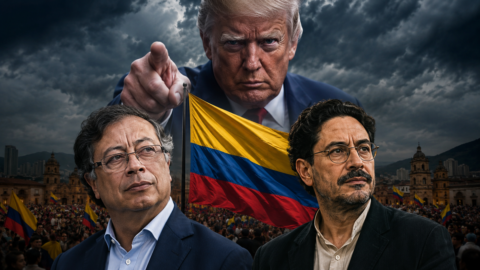
The first round of the presidential elections in Colombia will take place on Sunday, May 31., and it's no ordinary turnaround. The South American country is one of those that has (or was, it's still unclear) entered the crosshairs of US President Donald Trump, along with Venezuela and Cuba, as part of a renewed imperialist strategy in Latin America, in the name of the fight against narcoterrorism. After capturing Venezuelan President Nicolas Maduro and on the verge of delivering the final blow to Cuba after having left it in agony, the tycoon had also briefly threatened Colombian President Gustavo Petro, socialist, only to receive him at the White House last February.
In the polls, the government candidate Cepeda is in a very clear lead, with 44%.
Now, however, Petro, an ally in Latin America of Brazil's Lula and Mexico's Claudia Sheinbaum, who are certainly not the most popular leaders in Washington, is at the end of his term and will not seek re-election as president. To succeed him, the majority party Pacto Historico has chosen 63-year-old senator Ivan Cepeda, who is ahead in the polls of Trump's "backed" candidate, lawyer Abelardo De La Espriella of the far-right Defensores de la Patria party. Cepeda is expected to win 44,6% of the vote, up from the 37,1% he polled in February. but his main opponent is making a comeback with 31,6% In the latest projections, ten percentage points higher than the April poll. Trump has been busy with Iran in recent weeks and therefore hasn't had time to focus on De La Espriella, as he had done in recent months with Chilean José Antonio Kast and Bolivian Rodrigo Paz, both of whom ultimately emerged victorious.
De La Espriella draws inspiration from Trump and Bukele. Cepeda resists violence and intimidation.
De La Espriella, in addition to Trump, takes inspiration from Salvadoran President Nayib Bukele, who has become the leading figure of the South American right thanks to his brutal crackdown on crime and is obviously well regarded by the White House for this very reason. Senator and lawyer Paloma Valencia, from former President Alvaro Uribe's centrist party, is in third place in the polls, with 14% of voting intentions (a month ago, she was expected to be at almost 20%). Ivan Cepeda is therefore in the lead, having confirmed his candidacy despite numerous intimidations from organized crime: one of the latest episodes of violence dates back to April 15, when Cepeda's campaign headquarters in Medellín was vandalized, suffering structural damage and being defaced with graffiti on the facade.
The second round is scheduled for June 21. The United States is Bogota's largest trading partner.
However, to decree the new president a runoff election, scheduled for June 21, will almost certainly be necessaryAccording to polls, in a potential challenge to De La Espriella, the pro-government candidate Cepeda would win, but while a month ago the forecast was 54,6% of the vote against 42,6%, today it is 52,4% against 45,3%. The Colombian vote is therefore important not only for the geopolitical balance of an area where Trump, having closed with Iran, intends to re-establish his control, but also because Bogotá has the United States as its main trading partner, to which it ships almost 30% of its exports (including cocaine, according to Washington...). In total, Trade between the United States and Colombia is worth more than $53 billion a year..