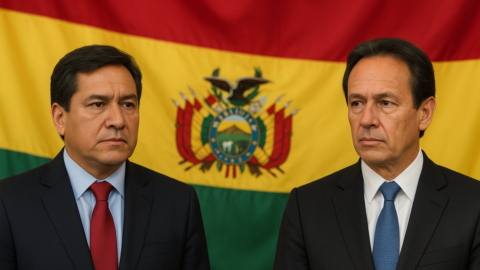
For the first time in twenty years, Bolivia will have a non-socialist president. presidential election runoff on Sunday, October 19 Indeed, two right-wing candidates are competing against each other, after the Movimiento al Socialismo, in power uninterruptedly since 2005, ran divided in the first round last August and ended up failing to field a candidate in the second and decisive round. The failure of the party of former President Evo Morales and of the outgoing President Luis Arce, both of whom were not candidates in this round (the former because he was ineligible and embroiled in legal issues, including a conviction for sexual assault against minors), has thus paved the way for the liberal and pro-American Jorge Tuto Quiroga, 65 years old and already head of the government from 2001 to 2002, and the Christian Democrat Rodrigo Paz Pereira, 58 years old, himself a liberal to the point of promising “capitalism for all”, that is, more accessible credit and lower taxes.
Polls give Quiroga the lead but there are 10% undecided voters
The latest poll published a week before the vote by Ipsos for Unitel reported former president Quiroga clearly ahead with 44,9% of preferences, while Paz Pereira would be stuck at 36,5%. However, the game is still theoretically open because, as can be seen with the naked eye by looking at the percentages, there is a large margin of undecided voters, quantified by Ipsos at almost 10% (5,6% would invalidate their ballot and 3,7% would vote blank). What is certain is that in any case, Bolivia will turn the page, and this will also have consequences on the geopolitical level. In fact, during the twenty years of socialist rule, the Andean country maintained an anti-imperialist and anti-Western stance, orienting itself more towards relations with China and especially Russia. It is no coincidence that under the Arce government Bolivia joined the BRICS and above all, it has strengthened relations with Moscow, not condemning the invasion of Ukraine and making available to its ally its impressive reserves of lithium, a metal fundamental to the energy transition.
Trump has already "endorsed" the two candidates and is ready to enter the lithium race
Bolivia in fact holds an estimated 23 million tons but at the moment contributes only 1% of total global production of the precious mineral, as the outgoing government focused instead on the export of natural gas and other raw materials. The result is an economy that, after an undeniable period of strong growth in recent years, has become severely deindustrialized, with inflation expected to rise to 25% in 2024 (a 17-year high), and the cost of living becoming unsustainable for a large portion of the population. In La Paz and its surroundings it's becoming increasingly difficult to find dollars and gas pumps stocked and at affordable prices. Now, however, "white gold" is tempting everyone: Putin's Russia has gained an advantage, but whoever wins between Quiroga and Paz will likely have to wink at Donald Trump's United States. Both have openly hinted at this, and the tycoon has appreciated it, pointing to Bolivia as a potential new strategic ally, with a focus specifically on lithium.
The two candidates' proposals: Quiroga wants to dollarize the economy à la Milei, Paz focuses on the fight against corruption.
The more pro-American of the two candidates is Quiroga, who is aiming to modernize the country with huge investments in technology and above all by flooding the domestic market with dollars, thanks to the support of the United States and organizations like the International Monetary Fund, much like Javier Milei's Argentina is doing, with mixed success. Paz Pereira, on the other hand, would first like to complete a tough fight against corruption and de-bureaucratize the country, and only then resort to external aid. In particular, he has promised to personally and rapidly negotiate with gas stations to unblock a situation that is paralyzing the Bolivian economy and people's lives. However, he also proposes: to move away from the anti-imperialist ideology This marked the twenty-year reign of Evo Morales, who, while he did elevate Bolivia to a new economic and social level, ultimately triggered the most serious crisis in the last 40 years. Now, the page is being turned, under Trump's watchful eye.