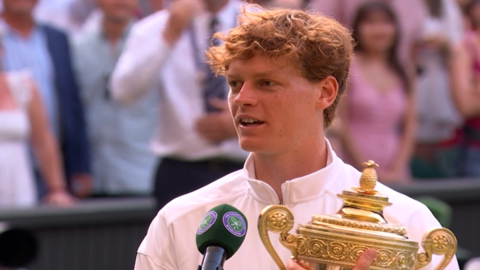
It will be theSinner effect, it may be the usual good reputation and quality of products made in Italy, but the fact remains that the Italian sporting goods industry is first in Europe in terms of exports. Indeed, according to the first Mediobanca report on the Sports & Outdoor market we are the only country with a positive trade balance: 644 million euros in 2023, that is the balance between 3,344 billion in exports and 2,7 billion in imports. Not only that: while the average of our companies is characterised by a lower turnover than those of other European countries, the average turnover of Italian sports goods manufacturing companies stands at 3,4 million euros, more than double the community average of 1,5 million and – for example – more than three times that of our French neighbours (1,1). Evidently the Made in Italy It is a winner, indeed, even in sport, from results (read Jannik Sinner, in this historical phase) to manufacturing and design.
And we're not talking about a small business, given that according to Mediobanca's Research Department, global Sports & Outdoor turnover will reach €363 billion this year. In this scenario, Italy is the leading exporter of sporting goods outside the EU by value, ahead of France and Germany, controlling a fifth of these exports. Specifically, we are leader in five specialties: gymnastics and athletics equipment, sports footwear, target shooting rifles, water sports clothing, skis, and skates. What does Sinner have to do with it? It does, because Italy is also the second largest exporter of tennis-related articles, as well as being the second largest exporter of winter sports products (the winter sports sector is the most concentrated, with Austria, Italy, and France accounting for 76,1% of exports) and the third largest in the cycling sector. European Commission figures also indicate our country as the leader in revenue: 22% of EU turnover generated by sporting goods manufacturing companies is Italy, which ranks first on the podium ahead of Austria (14,8%), Germany (14,7%) and France (12,3%).
Major Italian operators: preliminary 2024 results and 2025 expectations
Preliminary figures for 2024 indicate a 0,4% increase in turnover for the major operators
Italian Sports & Outdoor (+3% expected by the Major Italian Fashion Companies). After the two-year normalization period of 2023-2024, the expectations for the Italian sports sector for 2025 appear cautiously optimistic: estimated turnover growth It is expected to settle at around 3%, exceeding 12 billion euros. However, the forecasts are affected by the challenges of a constantly evolving international scenario: the unstable geopolitical context is the primary cause for concern, involving the
72,7% of Sport & Outdoor companies.
A further critical issue is represented by theincreased price competition, declared by 63,6% of companies: the reduction in price lists of operators in the sector is seen as a concrete risk to their market stability. Conversely, competition on product quality is less noticeable and concerns only 9,1% of operators, a lower percentage than that declared by companies in the Italian IV capitalism (14,3%). This is also attributable to the specialization of sports companies in increasingly innovative and higher value-added products, which protect them better from this risk. The repercussions deriving from the protectionist agenda of the new American administration are worrying almost half of the operators, especially those most exposed to the United States, the second largest market after Europe for Italian sporting goods.
To address these critical issues, most Sport&Outdoor companies focus on investment in technology and the development of new products. The importance of innovation for these operators is confirmed by the desire, clearly expressed by a third of them, for more profitable networking with universities, public institutions, and other players. In terms of capital strengthening, self-financing remains the primary source of funding for 83,3% of companies. However, access to credit is not a problem for nearly 60% of them.
Commitment to sustainability
Many Sport&Outdoor companies have started ESG initiatives, driven by an enlightened entrepreneurial vision and by market demands, but a quarter of them do not give visibility to sustainable initiatives activated. On the operational front, 72,7% of companies are committed to developing products with specific sustainability requirements, also leveraging the aforementioned centrality of technological innovation, as well as to the virtuous management of their waste by promoting recycling, while 63,6% are focused on reducing fossil fuels and using renewable energy.
Sport&Outdoor companies are also called upon to achieve carbon neutrality to combat climate change by 2050. Currently, 66,7% of companies are already involved in defining their own emissions reduction targets: 55,6% are in the process of doing so, and 11,1% have already done so, albeit internally. However, a third of companies are not yet able to quantify these targets or do not currently believe it is necessary to engage in this activity. Furthermore, only 44,4% of operators believe the "Zero Emissions" goal by 2050 is realistic.
The performance of the Italian sports industry in detail
The 82 Italian companies in the Sport & Outdoor sector selected, each with a turnover of more than 19 million and a workforce of more than 50 units, recorded an added value equal to 0,15% of the national GDP in 2023 and developed an aggregate turnover of 11.728 million euros (+0,6% on 2022 and +19,2% on 2021), with the employment of nearly 50.800 employees (+4,6% over 2022 and +14,9% over 2021). The most representative category is that of Mountain Attitude operators (29,0% of aggregate revenues), ahead of generalist distribution companies (26,2%); followed by manufacturing companies classified in the Multisport (14,5%), Cycling (11,2%), Motorsport (10,1%), Activewear & Lifestyle (5,3%), and Water Sports (3,7%) sectors.
Manufacturing companies are also distinguished on the basis of their prevalent product specialization: the producers of sport equipment (53,1% of aggregate revenues), ahead of those of clothing (27,0%) and footwear (19,9%). A further subdivision concerns the production organization, which can be internal or outsourced: with 88,1% of the aggregate turnover, players with in-house production prevail, while non-factory operators (11,9% of the total) delegate production processes to selected external suppliers.
A market with a Nordic focus and few foreign operators
The Italian sports industry is concentrated in the North of the peninsula: over half of the aggregate revenues come from companies in the North East (52,4% of the total), followed by the North West (38,0%). The shares of the Center (9,0%) and especially of the South and Islands (0,6%) are marginal. This is a peculiarity of this industry which distinguishes it from the Italian fashion industry whose revenues are more evenly distributed across the country: 38,9% North West, 33,6% North East, 24,9% Center and 2,6% South and Islands. Regarding manufacturing companies only, the Veneto It alone generates 36% of the total turnover (with nearly 90% generated by the provinces of Treviso and Vicenza), compared to 20% for Trentino-Alto Adige and 17% for Lombardy. These figures are largely driven by the leading role played by the Sportsystem district of Asolo and Montebelluna, which holds the world leadership in the field of technical and winter sports footwear.
In Sport & Outdoor, the prevailing Italian-controlled companies representing the 75% of sales overall, while the contribution of foreign-controlled operators stops at a quarter of the total (13,7% are French and 4,9% American), a lower share than that recorded by Italian fashion where the presence of foreign groups, which favor the high-end range, reaches 41,9% of total revenues (20,5% are French and 4,4% Swiss).