The economy is picking up speed: it's not a Indian summer
It's a Indian summer (or Indian Summer, for English speakers) prolonged by climate change? Or is itThe world economy is beginning to rid itself of new toxins. of the trade war, in which the US has used the ultimate weapon of tariffs, which have been added to the other protectionist instruments in place for at least fifteen years?
Yes, because the introduction of the duties is just the latest episode of a saga entitled , which has China and the USA as protagonists. A sort of duel style Challenge at the OK Corral, or better yet Hellish challenge, where the hero dies (this often happens from Homer onward). Readers can choose who, in this challenge, will wear the white hat of the good guy and the black hat of the bad guy.
(In the photo next to the title, Henry Fonda in Hellish challenge (My Darling Clementine), 1946, directed by John Ford).
The war began quietly as a result of the Great Financial Crisis, and until now had been fought with bans, incentives, subsidies for exports and imports and for domestic industrial production.
Whether it will be a fatuous autumnal summer or alasting acceleration The next few months will tell. The author has a certain bias toward the second hypothesis, assuming other risks don't materialize. This bias is based on data, starting with those PMI on production.
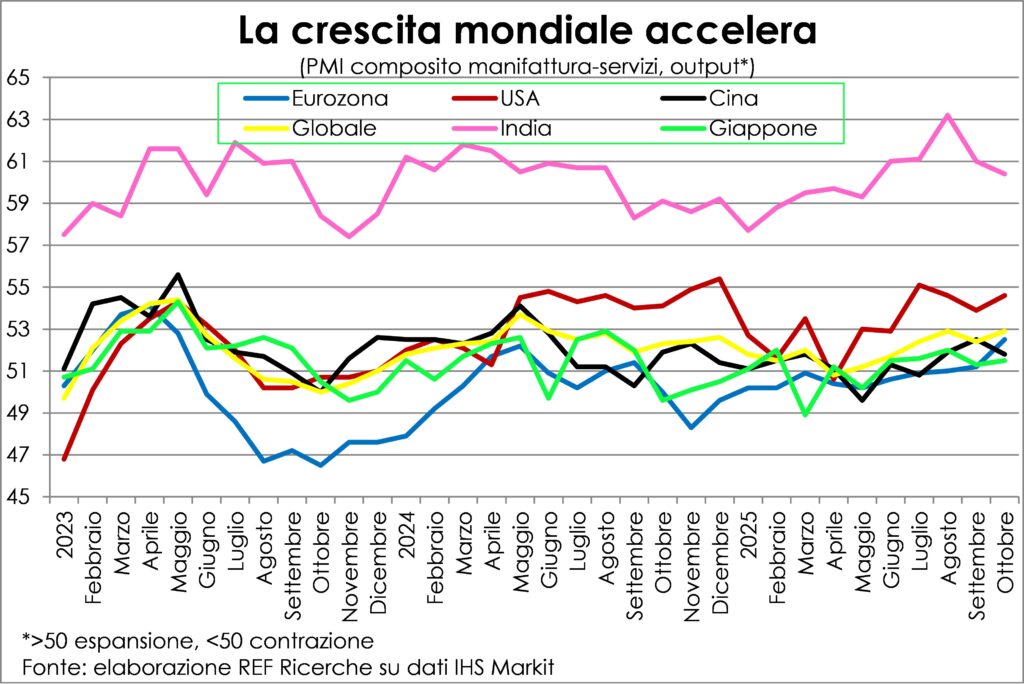
The US is pulling the world and Germany is pulling the Eurozone
The acceleration is led by the USA while China is slowing down a bit and India even more, but with stellar growth rates. It also participates the Eurozone led by Germany and SpainIn terms of pace, the undisputed leader remains the Iberian monarchy, but the German shot was remarkable and for the effects on the rest of the area his size makes him much more important than the excellent Spanish dynamics. It is the France now to have fallen to the unedifying role of ballast in the European convoy.
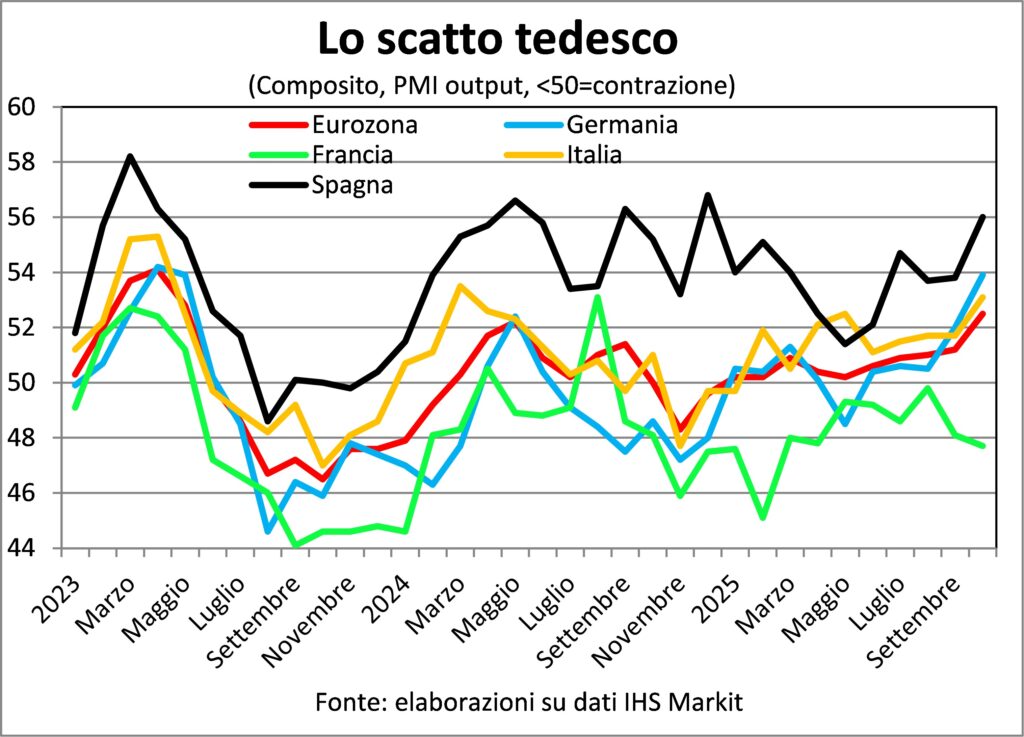
Italy has followed suit, but without wage increases it will be a factor in GDP
The Italy didn't need to be asked twice and promptly joined in: therefore the prediction that the Italian GDP to increase again in the current quarter, after the disappointing stagnation of the third quarter, which was unexpected even in the forecasts of the prudent Bank of Italy. A positive end to the year would give impetus to 2026, but to shake off the dynamics from you need a sharp increase in real wages, and the Government has put in place a good incentive for contracts to be closed in this way: now it is up to businesses to change pace, perhaps urged by a tougher union and determined.
As for the United States, in the vacuum of official data (which forces us to observe the economic dynamics as if through a frosted glass, catching the shifts of shadows) the tug of war between the labor market, which has lost its touch, and domestic demand, which is advancing undaunted, driven by the still large excess of consumer savings and the boom in investments in AI (or AI), which is however starting to save jobs. October marked a point for the second, given that the Private sector employment, according to ADP, increased by 42 thousand units, against expectations of a decline of 20 (and after the -29 in September). Whether this is the beginning of a real rebound, or just the start of a dead cat's shudder, will be decided by the statistics to come. Meanwhile, on the one hand companies are cutting a lot of staff (153 thousand in October, a 22-year high) and unemployment benefits remain stable at levels compatible with minimal unemployment. The mystery continues; we'll see you next time.
The strange case of the decline in exports
Is everything okay, then? There's the strange case of the continued decline in foreign ordersThis makes this acceleration anomalous and, perhaps, less intense. However, it's better to analyze it.
Normally, when domestic demand in countries is rising, sucks in imports, which are exports from others, and this suction stimulates production, employment, income, and demand abroad. The increase in foreign demand in turn absorbs imports and gives the carousel another spin, pushing production, employment, income, and demand elsewhere. This mechanism is a powerful flywheel which makes growth more choral, more solid and stronger, transmitting expansionary impulses from one economic system to another.
Instead, in this year of grace, which will perhaps go down in history as the turning point in changes in geopolitical balances and which started with the declaration of trade war by the United States and is ending with a sort of armed peace between the various contenders (especially between the USA and China), exports are not going well and remain stuck.
The October manufacturing and services PMI surveys confirm that a bit everywhere domestic orders rise but foreign orders fall, with varying intensities depending on the context. The only exception is India, which is a unique case because, as repeated many times in Lancet, it has taken off and is transforming into a global hub for manufactured goods and services.
Tariffs redraw strategies
Why are exports falling? With what consequences? The first culprit, of course, is the tariffs imposed by Mr. Trump, which were followed by counter-tariffs and countermeasures of various kinds, albeit avoiding retaliation that would have sent international trade into a tailspin. New trade barriers, both tariff and non-tariff, force companies to rethink their strategies operating on foreign markets: where, what and how to buy and sell across borders, perhaps looking for producers to supply from closer to you (nearshoring) and/or in countries that will not play political jokes or be banned (friendshoring).
Various types of “-shoring” had already been in place previously, since the Great Financial Crisis of 2008, as mentioned above. So much so that the elasticity of global trade to world GDP had shrunk. But what is happening now, that is, the fall in orders from abroad while those from within are rising, had not yet happened: a lower elasticity is one thing, another is the export movement in the opposite direction.
Among the reasons for this counter movement there is the fall in re-exports, that is, the resale abroad of previously imported goods. Indeed, many companies expand their catalogs by including products sourced from foreign suppliers (and not only foreign ones) and resell them under their own brand and thus with their own guarantee of quality. Ultimately, it's a service.
The duties have, instead, reshuffled the benefits of this activity And so the "retailers" are still considering countermeasures and may decide to stop importing and have the product shipped directly from the foreign supplier. This reduces exports twice: first from the supplier to the intermediary company, and second from the latter to its foreign customers. But since the demand for those goods hasn't disappeared, exports will rebound one of the times, and thus we'll have the same production with fewer exports.
The result is, however, to make the system work worse, at least for now. international demand transmission chain and weaken growth in manufacturing and the entire economy.
Inflation has dropped
The lost sheep has returned to the fold. This is the fairytale summary of the inflation returning to normal of how much is tolerated by Central Banks to maintain monetary stability, defined as the defense of the purchasing power of money.
Stability does not mean fixity and, for various theoretical and statistical reasons, it is good that prices move up a little, as a synthesis of upward and downward trends that incorporate changes in relative prices, which are important in signaling changes in convenience.
Riverbed and not roof because even a too weak or even negative trend in prices is both a symptom and a disease for the economy. This channel is "around 2%”; for the ECB the precise definition is below but close to 2%, but in Frankfurt, and elsewhere too, they would put their signature on inflation remaining at 2,1-2,2% for many months and years to come.
Looking at data around the world we see that This condition is substantially satisfied in the Eurozone: 2,1% annual total in October and 2,4% core. It is less so elsewhere: in the US in September it was 3% for both aggregates, in Japan 2,9% for both cases, in the UK 3,8% and 3,5%, in China it was -0,3% and +1,0%. However, in the American numbers they are by impacting the duties, whose effect for now is lower than expected both due to the dilution of their entry into force and the uncertainty about their level (more than the "feather in the wind" sung in La Traviata Verdi). In the case UK there has been an increase in social contributions at the expense of employers. In Japan's exchange rate weakness and the rise in food prices. In China the weakness of domestic demand.
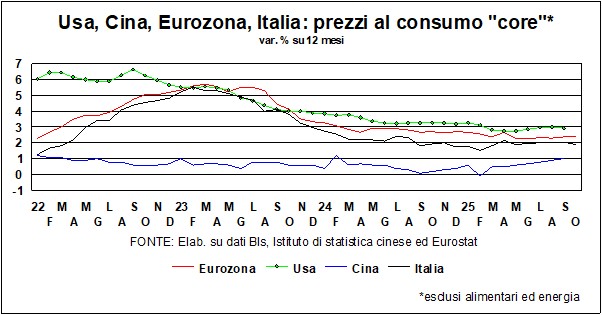
In short, there are many factors to consider, but the main one remains the cost of laborHere we observe a greater homogeneity of trends towards cooling (except for the UK). In the absence of official US data, for the shutdown, and Eurozone data, due to structural deficiencies, we rely on wages offered collected by Indeed for new positions.
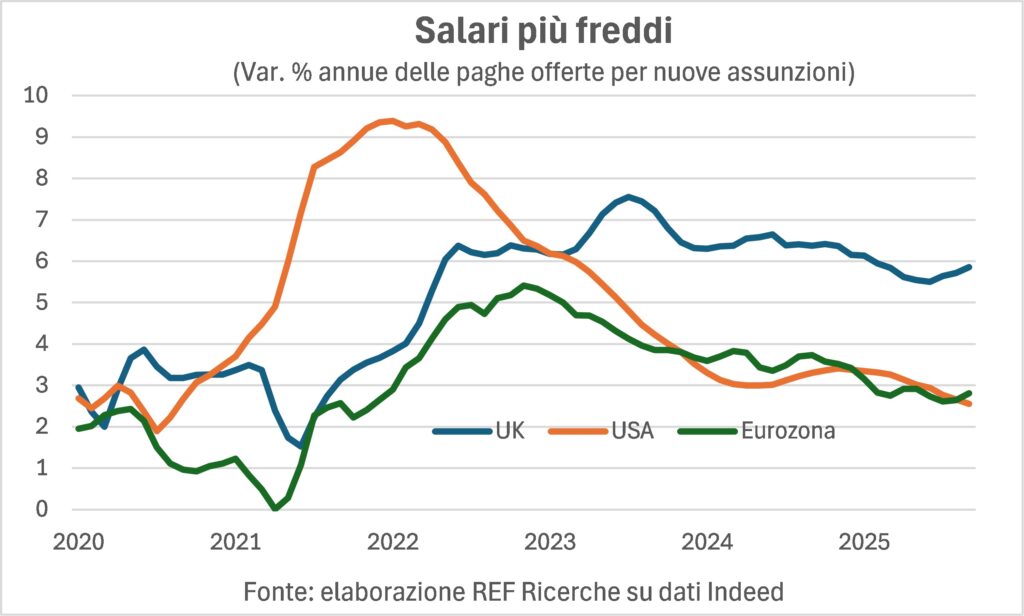
The in USA Their slowdown is evident. Other sources, such as ADP, indicate a virtually constant annual growth rate of 4,5% in October for those who have not changed jobs, but it was 7,8% in May 2022, and 6,7% for those who have changed jobs, down from 16,1% in April 2022.
Many researchers, including those from the Atlanta Fed and St. Louis Fed, they wonder if the job market American has not become structurally tight, that is, with less supply than in the past to satisfy demand, and if the USA has not entered into a higher inflation regimeThis could be true for many other countries and regions. For example, Brexit has reduced immigration in the UK, and there are stricter controls in the rest of Europe as well.
All this brings grist to the mill of the Lancette who have long maintained that the lost sheep has returned to the fold, but changed, and that the era of very low inflation It's not likely to resurface anytime soon. Not even with the productivity gains promised by AI.
On interest rates, deficit lurking
Expectations on the Central Banks' key rates continue to influence financial markets. The stock market gyrations, especially on Wall Street, look to next month, when the agonizing question – Will the Fed stand still or cut further? – it will be solved. The ECB has chosen to stand still, on the basis of some glimmers of revival in the economy and above all of inflation that has fallen (in any case the short-term real rate has gone from +1,3% in April 2024 to -0,4% today, so it is now expansionary), but Even in Frankfurt they will have to decide what to do in December.
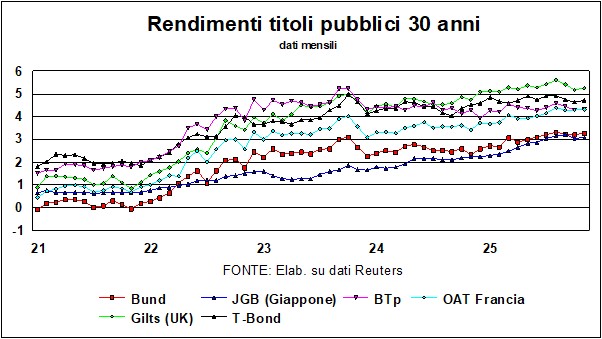
The interest rate game, however, is played mainly in the long term, where central banks, except in times of disaster, have less influence. long segments, at 10 and 30 years, the yields are on a waiting list, waiting, precisely, for the statistical darkness to be cleared up shutdown Let the dust settle over tariffs (but the aforementioned 'armed peace' does not promise true peace). But there is, over the long term, a long-sharpened and looming sword of Damocles: the financing needs of public deficits and debts, pressured by spending on infrastructure, defense, various transitions...
The last example comes from Canada, where the Carney government has presented a budget bill that significantly increases the deficit, especially for investments, but also to counteract the depressive effect of US tariffs. Carney challenges market judgments, and takes courage: he must have thought of the famous "To hell with torpedoes!" by Admiral David G. Farragut, who during the American Civil War led the fleet towards a mined sea, thus giving a decisive victory over the Southerners.
Perhaps the same thought must have been formulated Trump, when he pushed for the approval of that “Big Beautiful Bill” which causes public deficits and debts to soar (the latest estimates from the International Monetary Fund give, for 2029, US public debt at 143% of GDP, (leaving the Italian one in the dust). And, if we want to venture a prediction, the markets will be more lenient with Canadian debt than with American debt, if only because the former is expansionary even in its composition, and the latter avoids a restriction by maintaining the lower taxes on high incomes enacted in the past but not in the mix (cuts in investments and spending for the poorest to finance lower taxes for those who don't need them).
Apart from deficit financing, the other major influence on long-term rates – which after all are the ones that most interest families, starting with mortgages, and businesses because they set the bar for investments – lies in the inflation expectationsThese can be detected both from the family surveys, where they directly ask what inflation rate they expect in 1, 3, 5… years, both on financial markets, where long-term rate yields coexist, for bonds with or without inflation-linked interest rates.
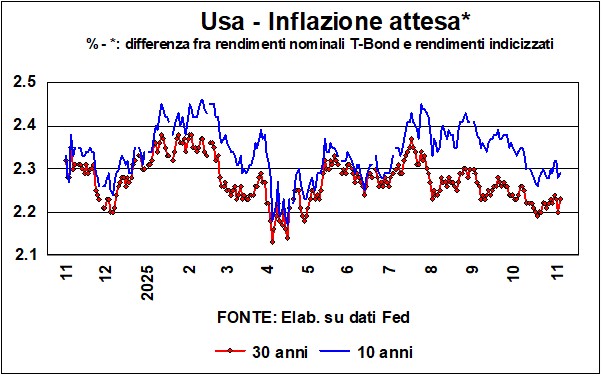
The difference between the two yields gives us a measure of expected inflation. Which of the two measures is preferable? Studies on the subject favor the second. In fact, the Consumers' opinions on expected inflation are much more variable than market expectations, where – it is assumed – the opinions of seasoned professionals, informed by the analyses of various researchers, prevail. Household expectations are strongly influenced by recent price trends, especially those associated with high-frequency purchases.
American data tells us that inflation expected by the markets, as highlighted by the difference – at 10 and 30 years – of the pairs of yields mentioned above, he shows no signs of particular concern, even if it remains 20-30 basis points above the famous 2% desired by the Fed. How much this will weigh on the Fed's decisions in December depends, as usual, on the data (which are always in limbo of the shutdown).
In the last meeting there was an unusual dissent in the decision to cut ratesUnusual, because usually those who break unanimity disagree for the same reasons. Instead, here we had the obvious Stephen Miram (who is technically still on the White House staff, which isn't great for conflicts of interest) that he wanted to cut back more; and Jeffrey Schmid, which he didn't want to reduce at all. If expected inflation is reassuring, the choice will depend on the information – which is scarce – regarding the other mandate, the one on maximum employment. statistics on layoffs (which adds up the layoffs announced by many large corporations) tell us that they are at the highest levels in many years (and this does not include federal employees set aside for the shutdown). But, according to some estimates, benefit claims remain low and private sector hiring has picked up.
BTp, spreads drop
For the btpThe news is good. After several upgrades to Italy's rating (we expect Moody's to upgrade it by the end of the month), the spread continued to fall, both compared to Bunds and to French Bonos and OATs (even if there is not much glory, ça va sans dire, compared to this latest improvement). About the France, even the spread 30-year BTP/OAT has fallen below zero, even if minimally; anyone who wants to invest in those long-term bonds by 2055, earning 4,3% annually, and is hesitant between France and Italy, should know that "this or that, for me, is the same."
Speaking of spreads, another surprising aspect, as far as 30-year bonds are concerned, is the fact that, from a year ago (November 2025 to November 2024), Yields on 30-year BTPs remained stable, while those on Bunds rose significantly.: the sensational abandonment of the 'brake rule' the deficit and the firm intentions to spend much more on defense and especially infrastructure must have influenced the long-term prospects, including the growth of the economy. So that BTp/Bund spread it decreased by almost 100 basis points (the most followed one, the 10-year bond, decreased much less, around forty points).

Dollar stable (for now)
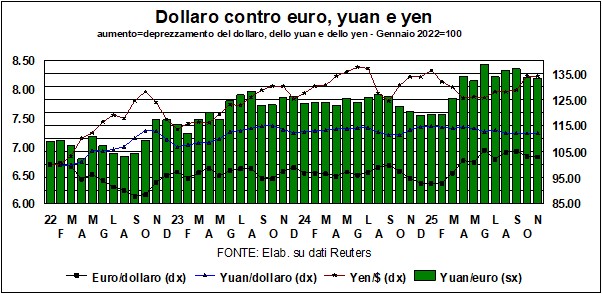
Let's get to the exchange rates. Here too, we're on a waiting list, waiting for the various clouds and clouds of dust to clear. A new development in the currency landscape is the change of government in Japan, with the first female prime minister in that country's history. yen It has weakened, partly due to concerns about the stability of the new government, partly because Sanae Takaichi favors expansionary policies, which could deter the Central Bank from raising rates. The yen's weakness, however, is not very recent. The chart shows how – setting the start of 2022 to 100, before the ill-fated invasion of Ukraine – The yen has depreciated more than the yuan against the dollar., and more than the dollar itself has depreciated against the euro. The one left to hold the lit match is the euro, whose uncomfortable strength has significantly improved the competitiveness of its major competitor China (see the Yuan/euro bars).
However, if the US trade deficit is to narrow, this will not happen because of tariffs, but only if Americans spend less (=recession) or if the dollar continues to weaken. Tertium non datur. And if there was recession (a big if), however, the dollar will fall, if only because rates would be significantly reduced.
In the markets, there is a smell of correction
In the markets there is a scent of inversion, as (should) be normal after the recent rallies. The descent from Olympus also affected gold and BitcoinAll three assets – stocks, gold and crypto – are riskier than cash or bonds, and are therefore subject to the ups and downs of risk appetiteArtificial Intelligence has come to support the stock markets (and the economy: in America, almost all of the growth in the first half of the year was due to spending on AI hardware and software), but here too the impression is that the price has been over-priced. Caveat emptor.
And then, the puzzle already exposed remains. If we look, starting from the month before Trump's election, at thestock market performance expressed in a common currency, Italy e Germany – manufacturing powers most sensitive to tariff blasts – have done best of all. And Wall Street is at the bottom of the list.
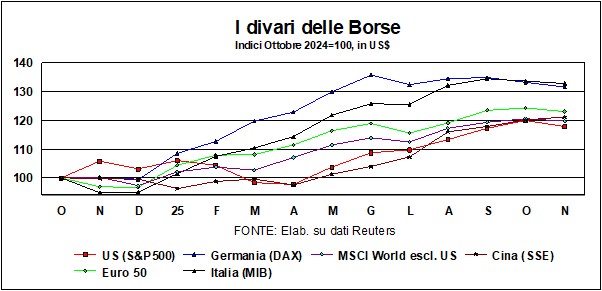
Not exactly what the stock market was expecting. apostles of MAGA...