The cinema has done the theater good
Il movies it was there natural evolution of the , after inventions and the technologies derived from it photography during the belle époque. In the ten and twenty years of the last century awave of creativity has poured on movies by artists and innovators especially in France, the United States and Germany. In a short time the movies ha developed its own autonomous language narrative and its own thriving industry. A new and powerful arrow has thus been added to the bow of the performing arts.
Il movies in its rapid development immense however, he committed a parricide, killing the ,. Indeed the latter, more than a century after the arrival of the cinematograph, has continued a thrive and has maintained and increased its place among the major arts. In 2014, for example, 37 new theatrical productions have been performed in the 40 theaters of the Broadway League in New York; they witnessed you 13 million people which generated a value of 1 billion and 600 million dollars. Also in the UK il , it is very large health. An analogous reasoning to that of cinema with theater could be done for television with cinema.
The ebook is a different book
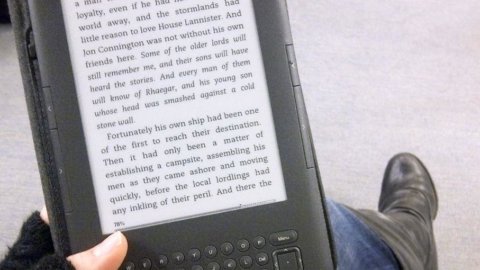
As the cinema is to the theater, so the ebook is to the book: even theebook it is none other than the natural evolution of the book in the new scenario of digital media. It is a passage that does not nor reversible nor geographically limited and therefore it is a fact. Obviously this step is not without consequences and as Heidegger taught us, the consequences of technique are anything but technical. There will be many changes with going digital. However, just as the cinema has not annihilated the theater, so theebook will not annihilate the book. Both means will have their own space which, however, we cannot yet glimpse well and can only imagine. Despite this relationship di generational affiliation between book ed ebook we are not witnessing a prudent and reasonable management of this transition, but we assist al paradox, bordering on the grotesque, that all main players of this important industry, which is thebook publishing, are committed to raise such and many obstacles, barriers and cages that the tree ofebook is suffering from dwarfism and book di decay physiological. It's true that there are huge interests at stake, tons of jobs at stake and that the experience of music is as terrifying as the ending to a David Cronenberg film.
The lack of vision of the incumbents
But this is enough to justify one lack of strategic vision? Following this state of affairs, happens which, instead of developing, thebook industry as a whole stands losing il discussion panel with The other media in conquering the new audience that lives on digital media and consumes content on a screen connected to the Internet.
With some significant exceptions and despite the fact that the ebook has higher margins than the book so as to make the reference shareholders happy and the managers who manage the business richer, for the major publishers theebook it's more a problem what an opportunity. Indeed the major publishers they are not investing nothing in the ebook either commercially or in terms of content; for them it is simply a new and quite annoying distribution channel of a book stored on a file sold on the net. THE great authors and theirs agents I am no less of their business partners. After a initial ed ephemeral falling in love for the ebook, writers medium-high rankings have started a perceive it as a deadly threat to their economic status, making a very simple equation ebook=Amazon=undermining the industrial assets that generate their well-being=enemy number one. Therefore if the early cinema benefited from a great wave of creativity by the artists of the time, the same not gonna happen with theebook which will have to await the growth of a new generation of authors eager to express themselves in this medium.
To pull up fence i have also made an effort technological taken in mechanism of a fierce competition and ruthless of all against all. The operational logic of the winner taking all the loot is in force. The eldest concern with large technology platforms, more than growing the market and hitting the existing industry with bold innovations, is that of conquer new consumers so from encapsulate them in their ecosystem commercial and technology, of which they will remain captive if they want to keep their investment in content.
Whose ebook is it?
The purchase of an ebook does not give rise to a property right, but is equivalent to a loan that can also be revoked.
It then happens that theebook lo It owns la platform, e de jure thepublisher: il reader can do little good that has purchased at a price not so far from that of a book. While with a book is surrendered to the buyer the full ownership and the buyer can do whatever he wants with it (lend it, resell it, donate it, bequeath it, give it to the town library or burn it to light the barbecue), with theebook immense is surrendered no property o related right: by purchasing an ebook the reader simply acquires the right to reading with a non-transferable license. In Amazon's words, the buyer acquires:
the non-exclusive right to view, use and display digital content an unlimited number of times, exclusively on the digital device or reading application… You may not sell, rent, rent, distribute, transmit, sublicense or otherwise transfer any rights in the Kindle Content or any portion thereof to a third party.
In short between book ed ebook pass the difference that is between property e loanbetween the United States, where ownership is eternal and transferable, and China, where ownership is revocable and limited. It seems that in the European agenda for the digital single market there is a will to put some remedy to this situation particularly as regards the content portability, blocked by the lack of interoperability between the different platforms, and lo legal status of the digital goods which can no longer be affiliated with the regulations governing the software, but must find innovative contractual solutions for goods/services that contain software plus content. An ebook is not software like a book is not just paper and ink. Software and paper are used to convey an act of creativity, they are a means to an end.
Among policies of incumbents (publishers, authors and agents), those of disrupters (technology platforms, internet intermediaries and start-ups) and those of regulators (governments and enforcement agencies) has come to create a sort of random convergence which has produced a short circuit which is holding the ebook in one minority status also on a legal level. Faced with such an involved situation, theenthusiasm , whereby many consumers have welcomed ebooks and continue to choose to read literature and non-fiction on their devices. However, if they took the trouble to read the contracts that regulate the use of the devices and that of the digital products that are loaded into them, perhaps this enthusiasm would dampen a lot.
What if the conditions of ebooks also applied to regular books?
Dennis Baron, professor of linguistics at the University of Illinois, has made important contributions to interpretation of the language of contracts and the advertising and communication materials that accompany them, trying to analyze their legibility. In 2009 you published a book entitled A Better Pencil: Readers, Writers, and the Digital Revolution where he examines how the revolution has affected writing practices and how the latest technologies, in this respect, are completely different from those that preceded them. Dennis Baron took the trouble to go and examine i contracts that consumers they subscribe when they buy an ebook to read on their iPad or Kindle. She did so in a post dated May 7, 2015 published on her blog entitled “What if printed books went by ebook rules?” which, in the translation of Ilaria Amurri, we offer to the readers of ebookextra.
It is better not to read these contracts and to act according to judgement.
* * *
To say it with Apple
I love books. Despite the monotony of the pages and characters, the scribbles and underlinings, i books are always comfortable, especially for the eyes of those who are a little older, like yours truly. Unfortunately, however, i modern books, i.e. ebooks, are wrapped up from an legal rent.
When reading withiPad, for example, you automatically accept the thirty pages di terms e condizioni ofiTunes Store. Legal language is so dense and boring that it seems designed so that no one can understand it, unless they are a lawyer, which is strange when you think that the terms of service si refer a books who have it purpose to be Beds.
But it doesn't matter, why Apple e Amazon they do not publish or sell their respective ibooks and ebooks for Kindle. I am "content providers” who act on behalf of third parties and apparently are convinced that the ebook immense are to be considered real books, so much so that Apple refers to iBooks with the term “iBooks Store products”, as Amazon calls books “Kindle content".
Let's take the contract of iBooks Store license:
You understand that iTunes sells to you the license to use content provided through the iBooks Store (i.e. the “iBooks Store products"). Once purchased from iTunes, this license forms a binding agreement directly between you and the publisher of such iBooks Store Product (The casa editrice) that governs your use of the same; iTunes is not a party to the license agreement between you and the publisher with respect to such iBooks Store Product; the publisher of such iBooks Store Product reserves the right to enforce the terms of use applicable to such iBooks Store Product. L'editor of each iBooks Store Product he is solely responsible for such iBooks Store Product, the contents thereof and the warranties thereof, to the extent such warranties have not been excluded, and for any claims you or any third party may have relating to such iBooks Store Product or your use thereof.
The limits of the license for the use of the iBooks store product
The agreement continues by defining the rules for using the iBooks store product:
(i) You are authorized to use the iBooks Store Products for personal use only, not commercial.
(ii) You are authorized to store iBooks Store Products by number maximum of five Accounts at a time on some iOS-based devices, such as, but not limited to, an iPad, iPod touch or iPhone.
(iii) You are authorized to store iBooks Store Products on a number up to five devices at a time (for example, a computer) who have installed the iTunes software.
(iv) The delivery of iBooks Store Products does not transfer any rights of use to you promotional iBooks Store Products or no right to burn iBooks Store Products on a CD.
(v) You will be able to manually sync iBooks Store Products from at least one iTunes Authorized Device with other devices that have a manual sync system, provided that the iBooks Store Product is associated with an iTunes Authorized Primary Device Account, where the primary device authorized by iTunes is the one that was first synced with the device, i.e. the one you subsequently designated as the primary device for use of the iTunes software.
After sipping thirty pages of this stuff Finnegans Wake it will feel like a walk in the park or, to put it , Apple, an integrated pedestrian experience within a recreational place surrounded by greenery. But be careful, if you get hurt in the park while reading the iBook don't try to blame Apple, they are just intermediaries who supply products without assuming any responsibility:
Under no circumstances the licensor will be liable for damages such as, but not limited to, personal injury, direct, indirect, incidental, or consequential damages, Licensor disclaims all liability for any damages or losses arising out of your use of, or inability to use, this product, for whatever reason , regardless of liability (in contract, tort, or otherwise), even if Apple is advised of the possibility of such damages.
To say it with Amazon
For read i "books true”, those that were once books and nothing else, immense has forced ad to accept no conditions. Imagine if in 1456 Gutenberg had presented the conditions of the Amazon Kindle Store to the potential readers of his Bible fresh from the first printing (“reader” is an archaic term to define what today is called “end user”):
1. Kindle Content
Use of Kindle Content. By downloading Kindle content and paying the applicable fees (including applicable taxes), the content provider grants you the non-exclusive right to view, use and display such Kindle content an unlimited number of times, solely on your Kindle device or reading application, or as otherwise provided for the type of service, solely on the number of Kindle devices or supported devices specified in the Kindle Store, and solely for your personal, non-commercial use. Kindle content is licensed to you for use and not sold by the content provider. The content provider may have additional terms of use with respect to its Kindle content. Those terms will also apply, but this agreement will prevail in the event of any conflict. Some types of Kindle content, such as periodicals, may not be available through reading applications. You may cancel your order for Kindle content without giving a reason up to 14 days from the date of purchase. Please see the Kindle Return Policy for information on how to cancel your order.
Limitations. Unless specifically stated otherwise, you may not sell, lease, rent, distribute, transmit, sublicense, or otherwise transfer any rights in the Kindle Content or any portion thereof to any third party., and you may not remove or modify any proprietary notices or labels on the Kindle content. In addition, you may not bypass, modify, overrule, or circumvent security features that protect Kindle content.
Guys, here we need Google Translate to understand something!
When Amazon invites you to buy a book with a click immense you longed seriously selling it to you rent and that's it, as the license agreement explains: "digital content is licensed to you, not sold, by the content provider."
In addition, the publishers themselves specify what we can and cannot do with ebooks. We take Dragnet Nation by Julia Angwin, published by Macmillan, and its unequivocal copyright notice:
The author and theeditor they have them provided this ebook only for his personal use and not commercial. Do not make this ebook available to the public in any way. Copyright infringement is against the law.
If the book had been like the ebook
And if all these rules were also applied to paper books? If you have a Gutenberg Bible, under the Kindle digital rights management agreement, you can't lend it, give it away, sell it at flea markets, give it to an adult literacy program, or put dried flowers in it. Come to think of it, you couldn't make it available to the public even in the context of a religious function.
To be sure, unlike Apple, which is loaded with cash, Gutenberg was barely making ends meet on Bible sales, even though today the few surviving copies are worth millions. However, if Gutenberg had had the foresight to rent the Bibles instead of selling them en bloc, his heirs would still continue to hold the rights to those books or rather those "sacred analogue artifacts containing the Holy Scriptures".
What if you were forced to accept some restrictions in order to read one of the "sacred analog artifacts containing the Holy Scriptures" printed in the fifteenth century by Gutenberg?
Today one supplier di digital content can to recover his ebook in any time, if theuser violet one of condizioni.
Here's how Amazon puts it:
We reserve the right di prevent access to the site and/or to Amazon services, suspend o to close un account, to remove or modify the contents of the site a our discretion, in case of violation of the applicable legal provisions, of these general conditions of use or of the applicable guidelines or policies. If you do not agree to the terms of this agreement, you are not authorized to use the Kindle device, any reading application, or the service.
No think it is one empty threat. But then, when Amazon discovered that they had sold a few copies of 1984 by George Orwell without having the copyright to that specific edition, hush hush ha removed il title dai Kindle of all United States. To the readers it seemed big brother stuff, but the publishing giant didn't give a damn, because just like big brother Amazon it has the law on its side. If the Gutenberg Bible carried an end-user license agreement, where you initialed yourself with a quill pen in order to access its sacred content, Gutenberg.com would be free to take it back if you weren't enough devotees or if you stained it with coffee or if instead of reading it you put money or flowers in it.
Do not abuse consumers' patience
Today i readers accept il license agreement without thinking for a moment and despite the thick legal curtain le ebook sales they go always meglio. But if Gutenberg's lawyers had come up with a way to put a overdrive to the freedom di use of the analog books, perhaps i readers of the time they would be kept their parchments and their clay tablets and the revolution triggered by rotogravure immense would never occurred.
After all, ebook vendors don't sell books, like Gutenberg and his successors did, but they sell the right to read them. It's a bit like selling the right to vote or think or breathe and in Gutenberg's day no one would have accepted it, so why should we?