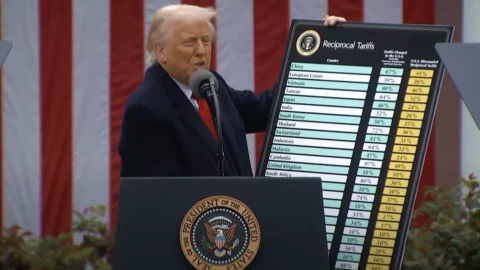
One after another, as the American economy seems to worsen, increases in customs tariffs leaving in August they come halved or postponed and even cancelled and on which the Supreme Court will shortly rule (The verdict was initially expected on Friday, January 9th, then the date was postponed to Wednesday the 14th). The latest in chronological order are the 50% tariffs on furniture and pasta, postponed for a year. Yet, as US government spokespeople have often smugly emphasized, the tariffs that went into effect in August would have had positive repercussions on the deficit and would not have had particularly negative effects on inflation, employment, or supplies. This is not the case. Leading geopolitical and economic experts have emphasized that the effects have indeed been felt. And that 2026 will be hit by a wave of consequences Decidedly severe. Numerous local news reports, surveys by some states, and reliable research centers have already revealed some very worrying data and trends. There are 10 critical points in the government's tariff policy.
1- Data stuck in the 3rd quarter
In reality, the few hard data that should justify this optimism are nonexistent, because the latest official data from the U.S. Bureau of Labor Statistics, which, like all government offices, was closed from October 1st to November 12th, only cover the third quarter. This optimism, therefore, is based on erroneous inferences.
2 – The rush to import
Already in November, when Trump, winner of the elections, announced double-digit tariff increases, a frantic order flow from the United States to suppliers around the world, to fill warehouses and avoid price increases. This is what had a positive impact on the economy. Then, the problems began.
3 – Damage to small and medium-sized enterprises
First of all, well before August, to be Small importers were the ones who were damaged, producers and distributors, many of whom escape national statistics. And then there are the reactions of the affected countries, which began well before August, with cuts in purchases of typical US-made products, starting with alcoholic beverages, such as the famous Bourbon. Jim Bean For example, it stopped production of its Bourbon at its Clermont, Kentucky factory, laying off employees.
4 – Retaliation against Made in USA products
A KPMG survey indicates that American products are losing ground rapidly. “60% of companies reported a decline in foreign sales in the first six months of Trump's tariffs. For example, U.S. liquor exports fell by 9% in the second quarter of this year, with sharp declines in the European Union, Canada, Great Britain, and Japan, which together purchase about 70% of these exports.” China, once a key customer for U.S. agricultural products, has turned – KPMG points out – toArgentina and other suppliers, and total exports of soybean US has fallen by 23% this year.
5 – Damages proceedings
Big come Costco, Revlon and Kawasaki Motors have filed million-dollar lawsuits against the US government because the increase in customs duties, which in turn led to sharp increases in the cost of imported raw materials and components, has become unsustainable for supply chains. This has resulted in heavy losses across every manufacturing sector. Hundreds of extremely serious lawsuits have been filed against the government.
6 – Layoffs already in January
John Deer, which imports steel and aluminum for its machinery has suffered losses of $300 million already in the first quarter of 2025, and has laid off its 200 employees. The same decision has been made by hundreds and hundreds of small and medium-sized businesses. And in fact, the Bureau of Statistics immediately announced that in just a few months it had recorded 33 thousand layoffs. Also increased due to the uncertainty of government policy.
7 – The very high costs for PIMs
Fortune published on December 29th an impressive list of damages: small businesses Female importers pay approximately 25 thousand dollars more each month; from April to September, 236 thousand of these importers paid an average of over $150 more than in 2024, based on data provided by the Central Chamber of Commerce. In six months, companies with fewer than 50 employees paid an average of more than 86 thousand dollars more and this the burden will rise to 500 thousand dollars in 2026. A very high percentage will close their doors. Layoffs have already exceeded 120. One last major burden: the extension of tariffs. de minimis, for small imported packages, is creating costly new bureaucratic rules with extremely complicated customs forms. UPS is overwhelmed by a customs backlog due to this new commitment.
8 – Damage to consumers
Goldman Sachs in one of its very recent analyses has disclosed the new costs arising from customs tariffs: 18 percent is paid by foreign exporters, 22 percent by US companies, and 5 percent will be evaded. The remaining 55 percent of consumers are paying it and will pay it with a significant increase in price lists. And inflation.
9 – Logistics overwhelmed
The products are missing and many shelves remained empty during the end-of-year sales. For example, 90 percent of consumer electronics comes from Asia, where the immense supply chain of tools and essential components for American factories also comes from. These have stopped in several states. It is noteworthy that the Internet and IT giants, like several other mega corporations, were…pardoned with tariff exemptions for their imported products. This treatment, however, was reserved only for those who had financed the party. Trump also imposed a hidden duty on steel and aluminum derivatives That is, a wave of new documentation (down to the smallest screw) to fill out, so many European exporters have stopped sales to the US. The first in a series was one of the largest European agricultural equipment manufacturers, Krone, which immediately stopped sales to the United States. For American farmers waiting for harvesting equipment, this means delays, shortages, and higher costs in the future.
10 – Corporations and associations are moving
After an initial, very gentle "reflection" period to avoid the President's brutal reactions, the "pillars" of the American economy took action, concerned about the crisis in many sectors. One of the most powerful and authoritative associations, the Cta, Consumer technology association (1.300 companies, turnover 505 billion dollars, 18 million employees) has warned three times, forcefully and since 2024, of the risks of its tariff policy.a National Retail Federation, which brings together American traders, addressed Congress with very harsh words: "American small and medium-sized businesses are disproportionately affected." The NRF's contribution to the economy exceeds 5,3 trillion dollars and it is the largest employer in the country. Confindustria USA, the National Association of Manufacturers (14,000 businesses, contributing $2,93 trillion to the economy, and employing 13 million people) has expressed criticism, particularly regarding import tariffs from Mexico and Canada, complaining that exports have been declining for nine consecutive months precisely because of this tariff policy. The criticism has been even more forceful from the United States Chambers of Commerce, which boast 3 million member companies and 880 registered businesses. And this is just a partial list, but it has already forced the President, with the support of millions of voters, to reverse his decision.