Investors expected that, as in the past, the Nvidia's excellent accounts they would have been a beneficial wave that would have swept through all the markets. But it wasn't like that this time, marking for some analysts the end of an era. The reaction of the markets today is warm, with investors unable to divert their attention from what has been worrying them in recent sessions: thedisruptive action ofartificial intelligence on many sectors of business. Furthermore, concerns remain about the US-Iran tensions, with the third round of interviews on stage today in Geneva, which keep the high Oil prices and that of , while the dollar goes down. Instead, he still celebrates the Korean Kospi which reaches new records, but US futures are down and European ones little changed.
Nvidia keeps its promises, but good is no longer enough
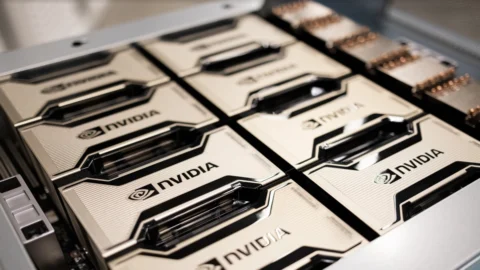
With very high expectations for Nvidia also a solid improvement in earnings failed to satisfy Investors seeking higher profits. Shares of the world's most valuable company remained unchanged (+0,2%). after closing time, reversing a brief rebound after results showed that the sales quarterly earnings exceeded analysts' expectations and a forecast of turnover for the current quarter more than Market projections: The chipmaker forecast first-quarter revenue between $76,4 billion and $79,6 billion, beating estimates of $72,8 billion. Some analysts had estimated figures closer to $80 billion, according to data compiled by Bloomberg.
The feeling is that the AI boom will no longer be the tide that lifts all boats, according to analysts. The tepid reaction suggests that investors may demand clearer evidence that earnings growth can justify high multiples before extending the rally. Nvidia shares have risen 4,9% this year, outpacing the gains of the S&P 500 and Nasdaq 100 indexes.
In recent days, markets have been shaken by a report from a little-known company called Citrini Research, which outlined the potential risks of artificial intelligence for various industries, using hypothetical scenarios set in the future. The technology's disruptive potential has roiled stocks across all sectors for weeks, in what has become known as the "AI fear crisis." Salesforce gave a tepid forecast for sales growth in the new fiscal year, fueling Wall Street fears that the software giant may lose ground to new competitors in the age of artificial intelligence.
Yesterday on Wall Street, all three major U.S. stock indexes rose ahead of Nvidia's results, with the chip-fueled Nasdaq posting the largest percentage gain: the Dow closed up 0,63%, the S&P 500 up 0,81%, and the Nasdaq up 1,26%. Futures are down 0,3% this morning.
Keep an eye on the third round of US-Iran talks today. Oil prices rise.
La geopolitics he kept throwing shadows on the markets. US and Iranian negotiators to meet in Geneva later today for the third round of interviews of this year on thenuclear activity of Tehran. At the same time, the United States has established one of its largest military deployments in the Middle East in view of possible attacks to the Islamic Republic. Trump had briefly outlined his reasons for a possible attack on Iran in his State of the Union address Earlier this week, saying it preferred to resolve the issue through diplomacy, but would not allow Tehran to possess a nuclear weapon. Iran maintains that its nuclear activity is intended for civilian energy production. U.S. rhetoric has kept oil prices high. Petroleum today, with investors concerned about a potential supply disruption in case of conflict. Futures on Brent grow by 0,16% to 70,80 dollars a barrel and those on WTI by 0,15% to 65,52 dollars a barrel.
The dossier also remains open duties, with Trump set to sign a directive in the coming days that will raise his global tariff to 15% “where appropriate” and is seeking “continuity” with nations that have trade agreements, U.S. Trade Representative Jamieson Greer said.
In Asia, Korea sets a new record, fueled by chips. In Japan, a tug-of-war erupts between the government and the Bank of Japan.
Asian markets are moving in mixed conditions, with the South Korea driving positive performance: the index Kospi Korean jumped more than 3,5% to a new all-time high. Although Nvidia showed uncertainty in after-hours trading, its results nevertheless triggered a rally among Asian chipmakers Kegati to society. On the front lines Samsung Electronics and SK Hynix, which also hit all-time highs, as the American giant's earnings point to continued sustained demand for advanced chips powered by artificial intelligence. Korean stocks were also supported by Bank of Korea, which left interest rates unchanged as widely expected, improving the outlook for economic growth thanks to growing optimism about South Korean semiconductor companies.
In Japan The Nikkei rose by 0,2%. The opposing forces between the desires of the Japanese government and those of the Central Bank of Japan they are reflecting on the yen, settling near a two-week low after the Japanese government he has appointed two academics, considered by the markets to be strong supporters of economic stimulus, on the board of the Bank of Japan. The move surprised dealers, who interpreted it as a reflection of the prime minister's accommodative monetary policy preferences. Sanae Takaichi, calling into question the prospects of further central bank interest rate hikes. Support for the currency came from Governor of the Bank of Japan Kazuo Ueda left open the possibility of a short-term rate hike, the local newspaper reported. Yomiuri, and Hajime Takata, a hawk within the BoJ board, has similarly called for a gradual tightening of monetary policy. Attention now turns to the next Tokyo consumer price inflation data, expected tomorrow: further signs of slowing inflation could reduce expectations of further rate hikes by the Bank of Japan.
The index Australian The S&P/ASX 200 rose 0,5%, hitting an all-time high as local mining and banking stocks continued to gain.
In China The Chinese CSI 300 and Shanghai Composite indices fell slightly, taking a breather after the strong rally of the last two sessions. Optimism for theincreased consumer spending had been strongly supporting both indices until yesterday during the Lunar New Year holidays. The index Hong Kong Hang Seng falls 0,5%, with local tech stocks falling: the giant Baidu loses more than 2% while waiting for the results.
While operators evaluate the tensions in the Middle East andimpact of tariffs US on global trade rose, touching $5.200 an ounce, the Bitcoin fell 1% and U.S. Treasuries gained ground, with the yield on the benchmark 10-year note falling one basis point to 4,04%.
European stock markets saw a breakeven opening. At the Milan Stock Exchange, attention was focused on Poste Italiane, Stellantis, and Tenaris.
European markets are expected to open at par: Euro Stoxx 50 index +0,1%
Eni – The fourth quarter ended with adjusted pro forma operating profit of €2,87 billion, up 6%. Adjusted net profit rose 35% to €1,20 billion, exceeding expectations of €960 million. The third tranche of the 2025 dividend of €0,26 per share was approved.
Leonardo – It could sign a joint venture agreement for its aerospace unit by the end of June, CEO Roberto Cingolani said. The group has been in talks with a financial and industrial partner for over 14 months.
Pirelli – It closes the 2025 financial year with improved earnings and revenues and a reduction in financial leverage that allows for the payment of a special dividend.
Poste Italiane – It closed 2025 with record revenue and 10% growth in net income. Adjusted EBIT guidance is €3,3 billion, with net income of €2,3 billion.
Prysmian – It closed the fourth quarter with a 20% increase in adjusted EBITDA, slightly below market expectations. It forecasts adjusted EBITDA between €2,63 billion and €2,78 billion for 2026.
Stellantis – In the second half of 2025, it recorded a net loss of 20,1 billion euros after previously announcing extraordinary charges of 22,2 billion.
Tenaris – Intesa Sanpaolo has lowered its rating to Neutral from Buy.