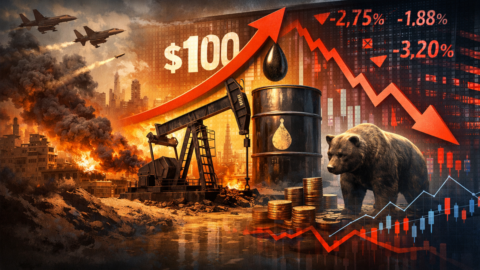
new duties, Petroleum at one hundred dollars, collapse of Wall Street, Asia falling, fears for the'inflation and rates: It's too much even for the most optimistic investor who is selling today ahead of the weekend. Yesterday on Wall Street, there was heavy selling in the stock market. tech, after the results of A e Tesla, while i shopping they moved on the defense sector, with Lockheed e Rtx, and then move in the after hours on Intel. European stock markets saw little change at the start.
Trump revised his tariff plan at the stroke of midnight and imposed new tariffs of 10% and 12,5% on 60 trading partners.
Administration Trump he imposed new rates of 10% and 12,5% on goods coming from 60 business partners, including theXNUMX-XNUMX business days , China, due to alleged violations of forced labor bans, just as a temporary 10% global tariff expired at midnight yesterday after 150 days. The new duties went into effect at the same time. This move represents the White House's latest attempt to restore the electoral vision Trump's near-global tariff, after the Supreme Court of the United States in February had cancelled The "reciprocal" tariffs of 10% to 50% imposed last year under a national emergency law to try to reduce the U.S. trade deficit. The new tariffs, announced yesterday in a notice published in the Federal Register cover 99,4% of US imports, but include numerous exemptions for certain products, such as oil and gas, fertilizers, and some food products. Imposed under Section 301 of the Trade Act of 1974, the new tariffs allow the administration to maintain a minimum tariff level on virtually all US imports, despite the Supreme Court's setback. These tariffs are also likely to face less legal risk than those repealed in February, as Section 301 has withstood previous court challenges.
Oil remains above $100 due to the disruption in energy trade. Fed rates will be closely monitored next week.
Oil prices Brent they have maintained themselves over $ 100 per barrel this morning, heading towards the fourth consecutive week of increases, driven by concerns over the disruptions in energy flows in the Red Sea and from the fears of afurther escalation in the war between the United States and Israel against Iran. Brent crude futures rose 37 cents, or 0,37%, to $101,06 a barrel, after closing the previous session up 7% above $100 for the first time since May, following the declaration by the pro-Iranian Houthis that they had attacked two Saudi oil tankers in the Red Sea. The contract is on track to close the week up 14,6%.
West Texas Intermediate (WTI) futures were virtually unchanged at $91,20 a barrel, the highest level since June 11, and are on track for a weekly gain of 11,8%. Rising oil prices have raised concerns about theinflation a few days before the monetary policy meeting of the Federal Reserve.
Yesterday only one oil tanker managed to cross the Strait of Hormuz, according to data from ship tracking analytics firm Kpler. The sea route of Bab al-Mandeb control access from Red Sea to the Indian Ocean and is the second most important oil channel after the Strait of Hormuz. The US military has launched another series of air strikes against Iran, and the 'Iran responded with fire against U.S. bases in neighboring countries. Trump promised "severe military retribution" against Iran and the Houthis after Yemeni fighters struck two Saudi oil tankers in the Red Sea.
Wall Street falls sharply, led by Alphabet and Tesla. Defense and Intel gain in after-hours trading. The fear index rises again.
Yesterday the indices of Wall Street closed down, with the Nasdaq which lost more than 2%, as the latest earnings updates from major tech companies rekindled concerns about massive spending on artificial intelligence, while soaring oil prices amplified inflation fears, pushing up bond yields. The S&P 500 Index fell more than 1%, with losses across the board, following the second-quarter results of A e Tesla. The Dow Jones closed at -0,97%.
Investors have move to the industrial sector who saw a up 1,77% thanks to the push of the defense titles, including Lockheed Martin and Rtx. The shares of Lockheed rose 10,5% after the company raised its sales and profit forecasts for 2026. Rtx was the second-biggest gainer on the S&P 500 index, closing up 7,3% after raising its 2026 sales and profit forecasts thanks to demand for commercial aircraft and military systems maintenance. Similarly Thermo Fisher Scientific rose 8,7% after the medical device maker raised its full-year profit forecast and beat estimates for second-quarter results.
The actions of A, Google's parent company, are dropped by 7% after the company announced higher spending plans and simultaneously burned through cash. The stock's decline also dragged down the communication services index by 5,20%. The consumer sector also fell by 5,12%. The main driver of the decline was Tesla, whose actions are dropped by 14,5% after reporting negative free cash flow in the second quarter for the first time in more than two years.'semiconductor index' Philadelphia stock closed down 0,5%. The analog chip company Texas Instruments closed down 3%, despite forecasts for better-than-estimated quarterly revenue.
The chip giant Intel Instead, which published the quarterly data after the closing of official trading, in the after hours saw a rise of 10% thanks to the forecasts of profits and revenues above estimates This has encouraged the company to increase spending plans over the next two years, as the construction of an artificial intelligence data center drives demand for central processing units (CPUs). Intel expects third-quarter revenue of $15,8 billion to $16,8 billion, compared to the average analyst estimate of $15,1 billion, according to data compiled by LSEG. Adjusted earnings came in at 38 cents per share, compared to the 27 cents analyst estimate.
LWall Street fear indicator, The Cboe Volatility Index added 2,06 points to 18,7, after previously hitting 20,3, its highest level in nearly a month.
As oil prices rose, inflation fears pushed up the government bond yields U.S. 10-year yields hit their highest levels since early 2025. However, traders continued to bet on a roughly 64% chance that the Fed would keep interest rates unchanged next week, according to CME Group's FedWatch.
Asia under pressure from the Kopsi and Nikkei. China injects liquidity.
The MSCI Asia Pacific Index is down 2,2%, its first session with a negative sign after three consecutive sessions with a positive sign. In South Korea, the index Kospi The Seoul Stock Exchange is losing 6% and the week is about to end with a 2% decline.
Some Asian hedge funds are selling Samsung (-7%) And SK Hynix (-3%) to make room for the purchase of shares of Cxmt, a memory chip manufacturer that will debut on the market July 27 in China. For the tenth consecutive day, due to the very strong price fluctuations, the so-called "sidecar" was activated last night, suspending trading for a few minutes.
In Japan the index Nikkei Tokyo is at -3% and the week closes with a drop of around 3,5%. Meanwhile, the yen continues to decline against the dollar and hits a new multi-decade high at 163,8. Japanese authorities have reiterated that they will take bold measures to counter currency market swings if necessary, while a U.S. Treasury report released overnight underscores that fears of excessive volatility are shared in Washington. Yields Japanese government bonds Ten-year bonds are up 3 basis points at 2,78%, again close to the long-term highs reached last month. Meanwhile,Inflation in Japan accelerates For the first time in three months, a figure that keeps the central bank on track for a further interest rate hike this year. The consumer price index, excluding fresh food, rose 1,6% in June from a year earlier, in line with expectations. A gauge that excludes both fresh food and energy—closely monitored by the Bank of Japan as a proxy for underlying inflation—rose 1,7%.
In ChinaHong Kong's Hang Seng Index is down 1,3%, for a positive weekly close of 1,2%. The CSI 300 index in Shanghai and Shenzhen is down 1,2%, up 3% for the week. Taipei's Taiex is down 2,5%, up 2,2% for the week. Chinese central bank has carried out the most substantial injection of liquidity into the economy over the past five months (500 billion yuan, equivalent to $73,8 billion) through its Medium-Term Lending Facility (MLF), to support growth ahead of the Politburo meeting scheduled for the end of July and to facilitate the issuance of government bonds. The size of the operation exceeds the size of maturing loans, resulting in a net injection of 100 billion yuan.
European stock markets opened little changed. At Piazza Affari, eyes were on Stm, Poste Italiane, and Unicredit.
European stock markets are expected to open at parity: Euro Stoxx 50 futures are up 0,1%.
EniThe government, in the Competition Bill approved yesterday, has established a €120 million fund between 2028 and 2030 for fuel distribution facility owners who choose to convert them into electric vehicle charging stations or biofuel production, according to a statement from the Ministry of the Environment. The measure provides a grant of up to €60.000, covering a maximum of 50% of the costs incurred, for each facility owner.
Poste ItalianeIt reported an increase in earnings and revenue in the first half of 2026, confirming its full-year guidance. Specifically, revenue reached €6,8 billion, up 5,9% compared to the first half of 2025.
stmIt will invest approximately 2,4 billion euros in Catania between 2026 and 2028 to strengthen its 8-inch silicon carbide capacity and 1,4 billion in Agrate Brianza, where it aims to bring production to 8.000 wafers per week by the end of 2027. This was confirmed by CEO Jean-Marc Chery at La RepubblicaJefferies maintains its Buy rating, but lowers its target price to €68 from €82.
UnicreditMediobanca confirms its Outperform rating and raises its target price to 100 euros from 92 euros.
Caltagirone PublisherToday the Board of Directors is meeting to discuss the half-yearly accounts.
Mare Group. Has signed a binding agreement to acquire 100% of Ctmavio for 9 million euros, 6 million of which in cash and 3 million in new shares, with closing by November 15th subject to approval by Golden Power.
The Italian Sea GroupIn addition to the interest in some assets of Azimut-Benetti, which has already signed a confidentiality agreement obtaining access to the data, discussions are underway on the creation of a nautical hub in Carrara involving one or two industrial operators and which could include Saint Lawrence, he writes this morning La Repubblica. The group would retain TISG's brands, concession, and shipyard management, and the operation would also be open to suppliers, the newspaper adds. A German shipbuilding group is also reportedly interested, potentially exploring an alliance with a large Italian group.
ZucchiToday the Board of Directors is meeting to discuss the half-yearly accounts.
BuzziJefferies maintains a Hold rating, but lowers its target price from 49,5 to 46,5 euros.