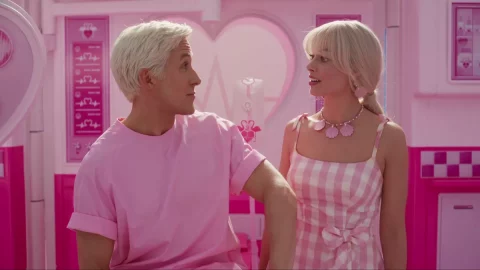
Generally the conservative leaning audience welcomed Barbie, the film by the couple Greta Gerwich and Noah Baumbach two of the most original authors of current cinema, with annoyance and even with a certain fury. Barbie doll burnings have also been seen on YouTube.
Barbie is not even an icon of the opposite and detested liberal side. Far from it. Hilary Mantel, the English writer of the Tudor cycle, two-time winner of the prestigious Booker Prize who recently passed away, in 2013 did not hesitate to define Kate Middleton, Princess of Wales, a "Barbie", that is a "plastic mannequin". In fact, after the release of the film, Middleton began to appear on official occasions with a powder pink outfit on stiletto heels.
In China, although screened in a few theaters due to the restriction of foreign films, the film received considerable attention and gave rise to a “Barbie mini mania”. The Chinese authorities, who don't have much sympathy for gender issues, sensing a possible reading of cinema in that key, have shifted the emphasis of the film's message towards the feminine rather than the feminist. In fact, the Chinese consider feminism a Western conspiracy to weaken the social cohesion of the Chinese state.
In China, the film was released with a subtitle that could sound like "feminilismo" in Italian and "women-ism" in English. That is, something that has very little to do with women's rights.
But is Barbie really a feminist film? Or rather is it the other way around?
This is what one of the most accredited asks himself columnist of the “New York Times”, Ross Douthat, of conservative orientation and as he says "film critic in his spare time".
What he writes is very interesting. We report it below in Italian translation. Those who have already seen the film can continue without problems, those who have to see it know that they will come across various spoilers.
Warning: There are major spoilers ahead!
The Dquestion of the New York Times
Greta Gerwig's film is indisputably feminist, crypto-conservative, or somewhere in between? Douthat wonders.
The simplest reading, she replies, is "feminist." The film portrays a doll city where the Barbies occupy all the jobs and the most important positions (with their Kens as testimonial). Here we see that all the women's problems are gone. Even the Supreme Court is made up of women only, for those who want to get the hint.
We also see that in the real world the situation is quite different. In contemporary Los Angeles, sexism still exists, patriarchy is cleverly disguised but prevailing, that girls hate goose dolls like Barbie. The latter discovers this real-world situation when she goes there on the advice of "Barbie freak (Bad Barbie)" - accompanied by a crash Ken - to understand the reason why her feet have become flat and she has thoughts of death.
Also in Los Angeles Barbie discovers that the Mattel board of directors yes, it is convincedly "feminist", but made up only of men, moreover idiots, and that there has never been a woman to preside over it. In the end women have to do whatever is asked of them for a meager fee.
This awareness of the real condition of women culminates in a long monologue by a Mattel employee in which it is quite easy to glimpse the political manifesto of the MeToo movement.
If to all this we add the fact that Ken (Ryan Gosling) falls in love with the patriarchy dream and organizes a macho putsch in Barbieland, as it can be written that in "Barbie" there are "conservative, anti-feminist themes, in favor of the traditional family and motherhood", as the moderate political commentator does, Michael Knowles of the Daily Wire.
From despotic to real
In part, the conservative spirit is piqued by the sheer amusement that comes from Gosling's performance, which makes Ken's macho awakening quite enjoyable and even liberating for male viewers fond of a certain way of thinking.
Actually some of the conservative themes are actually present in the film. Barbieland is a feminist utopia which seems fundamentally dystopian: plastic, denatured, where death is denied. Denial that extends to love, procreation, motherhood.
Indeed in the world where Barbies live there is no place for pregnancy and family. It's a totally and happily asexual world.
The film represents the Kenyan revolution in a parody way, caricature. Precisely because of its farcical character expressed by Ken's clothing, by the elevation of the horse to the new emblem of Barbieland, the pathos grows in the viewer, the sympathy for Ken and the awareness that he is doing all this upheaval just to impress Barbie and be accepted as boyfriend. After all, what are men for in the post-sexual revolution landscape if not to be welcomed by women?
Barbie's restorative reaction to the Kens coup is also part of the “humanizing” parable of the stereotypical Barbie. In fact, even with the discovery of her true nature, a progressive departure from the dystopian vision of pure and unappealable feminist domination takes place to return to femininity which is part of the real world with all its patriarchal residues, up to the possibility of motherhood.
A substantially feminist film
Douthat says he is convinced that this interpretation by Knowles and the conservative critics contains an error. To consider this material as a solid alternative to the aspects of the film they reproduce liberal and feminist arguments.
Barbie yes, it is a film with an evident feminist setting, but also with complicated and sometimes confused aspects of what the sexual revolution has opened up and about where feminism should go.
He's against resilient patriarchy, but he's wary of the matriarchal alternative.
She wants femininity and motherhood, but he doesn't want the Kens back in charge. He doesn't quite know what role men should be assigned. A man can literally stage a revolution, but that's not enough for Barbie to see him as a lover, partner, sex object, husband or father.
And so the film concludes – once again a major spoiler – with Barbie outside Barbieland but alone, longing for motherhood. We see her at the OB-GYN surrounded by a cheerleading squad, but with no Ken in sight.
Both Barbie and Ken
“My official position as a writer and part-time film critic – writes Douthat – is that i sequels are a bad idea, that a blockbuster original film should stand on its own rather than be slotted into the Hollywood franchise machine.
But in the case of Barbie I might make an exception, if only to see what Gerwig and her co-writer and partner, Noah Baumbach, think about bringing their Barbie and Ken together.
In the film they made, “Barbie and Ken” are a declaration of female dominance and male eclipse.
But actually, for the happiness of both genders and for the future of the human race – concludes Douthat” – there is nothing as important as the possibility that Barbie and Ken are able to transform that “and” into something reciprocal and constructive: a bridge, a bond, a marriage.
Sources:
Ross Douthat, Why Barbie and Ken Need Each Other, The New York Times, August 9, 2023
Vivian Wang, Siyi ZhaoWhy, 'Barbie' Became a Sleeper Hit in China, The New York Times, August 6, 2023