The European car market is trying to recover, but the situation remains weak. In February 2026, the Enrollment page in the European area (EU + EFTA + United Kingdom) reach 979.321 units, up 1,7% on an annual basis. A positive sign which however is not enough to compensate for theweak start to the year: in the first two months the volumes stopped at 1,94 million, down 1%This data is also confirmed when looking at the European Union alone, where February saw a 1,4% increase to 865.437 registrations, while the January-February period saw a 1,2% decrease.
The overall picture is that of a market still far from pre-Covid levels, with an estimated gap of around 18%, and characterised by very different trends among the main countries: Italy is growing (+ 10,2%) and Spain (+4,6%), while France retreats (-11,1%) And Germany (-1,4%).
Engines: Electric and hybrid dominate, petrol plummets
The real driver of the market remains the energy transition. In February all electrified power supplies are growing with the electric cars which recorded a +15,8%, the plug-in hybrids a 33% jump and the traditional hybrids a +10,4%. The picture for the two-month period is even clearer. electric cars represent 18,8% of the European market, up sharply from 15,2% a year ago. Hybrids remain the most popular choice, accounting for 38,7% of registrations, while plug-in models have risen to 9,8%, driven by particularly strong growth in Italy, Spain, and Germany.
On the opposite front, the decline of traditional engines continuesPetrol and diesel together fell to 30,6% of the market, with sharp falls especially for petrol (-23,3% in the two-month period) and a structural decline also for the Diesel (-17,7%).
La the spread of battery-powered cars continues, but with different speeds Among European markets, France (+38,5%) and Germany (+26,3%) led the growth, while Belgium and the Netherlands declined. Overall, the four main markets accounted for 61% of electric vehicle registrations, but exhibited diverging trends reflecting incentive policies, infrastructure, and domestic demand. The comparison between technologies is also interesting: pure electric vehicles have a higher share, but plug-in hybrids are showing a faster growth rate (+32,6% versus +14,8%), a sign of an ongoing transition phase.
Car registrations: Stellantis surprises and grows faster than anyone else
In a still uncertain European market, Stellantis surprisesIn February, registrations in the European Union reached 158.341 unit, up 9,8% year-on-year. The share thus rises to 18,3%, up from 16,9% a year ago. If we broaden our view to the whole of Europe (including EFTA and the United Kingdom), the group achieved 170.816 registrations (+9,5%), bringing its share to 17,4%. Even more significant is the two-month data: 335.426 cars sold, up 8,2%, with market share rising to 17,3%.
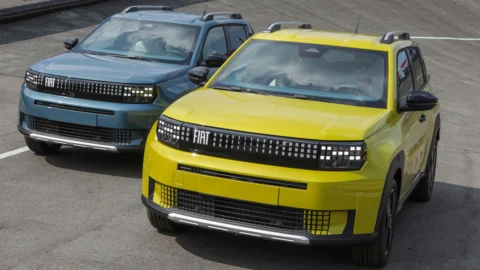
Stellantis is thethe only major manufacturer to improve its position, while most competitors remain in negative territory. In the European Union, the bimonthly share stands at 18,3%, while considering all European regions, the group is close to 19,2%, gaining about a point and a half compared to 2025. What makes the difference is above all the Fiat boom, the true engine of growth. In February the brand recorded a increase of 52,7%, with over 33.900 registrations. A result also supported by the success of the new models (The Panda above all) and strong demand in the domestic market. In the two-month period, Fiat continued to grow, with a +36,9%.
Next to Fiat, Opel/Vauxhall also make a decisive contribution, growing by more than 30% in the month and by 21,1% in the two-month period, and Citroën, which recorded a +9,6% in February and a +11,7% in the first two months. Weaker, however, are Peugeot (-10,1% in the month, -6,5% in the two-month period) and Alfa Romeo, which continues to post a double-digit decline. Positive signs, however, come from Lancia, which is returning to growth. In February, it recorded 1.275 registrations (+10,4%), while in the two-month period, it rose to 2.559 units, an increase of 15,9%. These numbers are still low in absolute terms, but they indicate a renewed momentum within the group.
Strategically, Stellantis is consolidating its presence in key segments of the energy transition. The group achieved leadership in electric car sales in the private BEV segment (B2C) in major European markets for the first time and strengthened its leadership in hybrid vehicles, where it exceeds a 20% share thanks to the boost from models based on the Smart Car platform.
Volkswagen leads, but others are slowing down
Despite the acceleration of Stellantis, the European leadership remains firmly in the hands of the Volkswagen GroupIn February, the German giant recorded 256.452 registrations in Europe, up 2,2% year-over-year, with its share rising to 26,2%. In the European Union alone, sales reached 230.228 units (+2,6%), bringing its share to 26,6%.
Renault, however, is losing ground. The French group has slipped sharply, with 91.619 registrations in Europe in February (-14,3%) and a market share down to 9,4%, down from 11,1% a year ago. The decline is also confirmed in the European Union, where the group sold 86.051 units (-15,5%), with a market share of 9,9%. The weakness is not limited to the French brand. several Asian manufacturers are experiencing a slowdownHyundai and Toyota closed the month with declining volumes, a sign of still uncertain demand and increasingly fierce competition on the price and technology fronts.
Ford's difficulty is even more marked, which in the two-month period recorded a contraction of around 20%, among the worst performances among the large groups and which also has to deal with problems in the USA where the recall of over 254.000 SUVs for software problems.
BYD doesn't stop, Tesla tries to recover
Continue without slowing down the advance of Chinese manufacturers in the European market. At the forefront there is Byd, which decisively accelerates and consolidates its presence: in February the group registers 17.954 cars in Europe, with a 162,3% jump on an annual basisMarket share thus rose to 1,8%, more than double the 0,7% recorded a year ago. This trend is strengthened over the next two months. In the first two months of 2026, BYD achieved 36.069 registrations (+162,7%), bringing its share to 1,9%. These figures confirm growth that is anything but episodic, supported by an aggressive strategy based on competitive electric models and increasingly targeted price positioning for the European market.
Next to Byd, yes also consolidates the presence of Saic MotorsIn February, the group recorded 22.360 registrations (+12%), with a 2,3% share (up from 2,1%). In the two-month period, volumes rose to 41.454 units (+4,8%), showing a more gradual but stable progression.
They emerge signs of recovery from Tesla. After months of slowdown, the Group returns to growth in February with 17.664 registrations (+11,8%) and a 1,8% share. In the two-month period, however, the increase remained limited (+0,9% to 25.753 units), indicating a still fragile but significant recovery in the context of increasingly intense competition for electric vehicles.