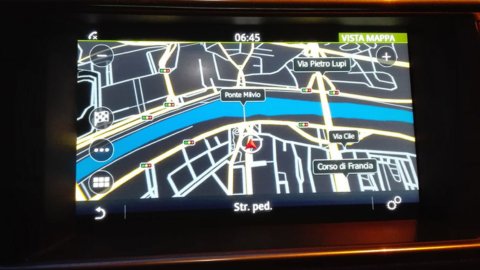
Innovative laser technologies and nanomaterials to create low-power devices which will project ad images onto the dashboard of cars very high resolution of radios and navigators, without having to install individual screens. This is the objective of the European research project MILEDI (MIcro QD-LED/OLED DIrect patterning) coordinated by ENEA, which will work for over three years together with nine partners, including the FIAT Research Center.
"We will develop new nanomaterials and cutting-edge laser systems to create 'quantum dot displays', i.e. quantum dot screens already used on smartphones, smart glasses and cameras" - he explains Francesco Antolini, ENEA researcher of the Micro and Nanostructures Laboratory for Photonics and project coordinator. These hyper-technological displays - continues the researcher - use semiconductor nanocrystals that emit light when they are pumped by a current or other light sources. And it is precisely the quality and brightness of the colours, together with low energy consumption, that have increased the interest of the automotive sector, and beyond. In particular we will focus – explains Antolini – on the creation of micro displays to be mounted on board cars, reducing costs for the installation of individual screens and enhancing the design of the car”.
But the benefits don't end there. “Within a few years – concludes Antolini – micro displays could be produced at competitive prices compared to other types of hi-tech screens based, for example, on LCD technology. Investing in photonics and micro- and nanotechnologies, as the MILEDI project is doing, will make it possible to strengthen the competitiveness of European industry and create new jobs”. Europe currently holds 20% of the global photonics market (about 60 billion euros) with about 5 companies active in the sector (especially SMEs), of which 200 are Italian.
The MILEDI project is funded within the European Union Framework Program for Research Horizon2020 (2014-2020) and sees ENEA's Department of Fusion and Nuclear Safety Technologies in the role of coordinator, together with Italian and international scientific institutions, universities and industries from Italy, France, Germany, the United Kingdom and Israel, such as the Fraunhofer Institute for Organic Electronics ( FEP), Technische Universität Dresden (TUD), Alternative Energies and Atomic Energy Commission (CEA-Leti), University of Modena and Reggio Emilia (UniMORE), MICROOLED (MOD), Ekspla UAB (EKS), School of Physics & Astronomy, University of St Andrews (USTAN), FIAT Research Center (CRF) and Advanced Measurement Systems (AMSYS).