I European duties on electric cars produced in China are changing the market balance, but the their effect remains partial. Since their introduction, the share of vehicles built in China The European electric car market has fallen by about five percentage points. This has prompted several Western manufacturers to relocate part of their production to Europe, but it has not halted the growth of Chinese brands.
It is the picture outlined by a new analysis by Transport & Environment, Europe's leading independent group for the decarbonisation of transport, according to which the competitiveness of Asian producers continues to rely mainly on prices. Despite the tariffs applied by the European Union, aElectric cars produced in China cost on average 21% less compared to a model made by European manufacturers.
For T&E, the risk is that Europe will become a "safety valve" for Chinese excess production capacity or will turn into a simple assembly hub. The organization therefore calls on Brussels to strengthen trade defence instruments, also extending them to batteries.
Western production returns to Europe
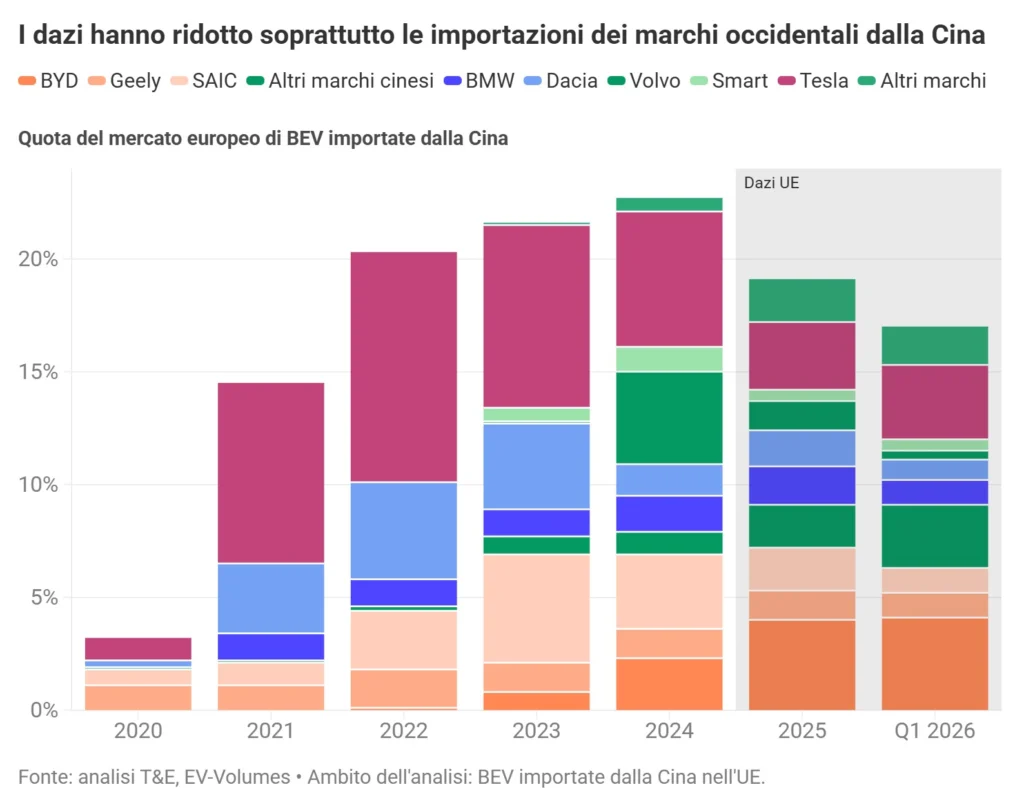
In the first quarter of 2026, battery-powered electric cars produced in China accounted for the 17% of the European market, compared to the peak of 22% reached in 2024, the year in which the duties were introduced. The decline is mainly linked to the strategies of Western groups. Tesla, BMW and Volvo have progressively transferred a part of the production from China to European factoriesThe share of European manufacturers in total Chinese electric car imports thus fell from 38% in 2024 to 23% in the first quarter of 2026. Over the same period, Tesla's share decreased from 26% to 19%.
The result is that today beyond the half of electric cars imported from China è made directly from Chinese automakers. The tariffs, therefore, primarily impacted the production decisions of Western groups, while the expansion of Asian brands continued.
La response The performance of Chinese manufacturers varied depending on the tariffs applied. Imports of electric cars from SAIC, which faced a 35% tariff, almost halved between 2023 and 2025. Byd, which faced a 17% tariff, more than doubled its exports to the European Union.
European factories and the growth of plug-in hybrids
Trade measures have productive investments in Europe also acceleratedSince September 2023, when the President of the European Commission announced the launch of the anti-subsidy investigation, Chinese companies have announced ten new industrial projects on the continent. Local production is one of the main strategies used by Chinese groups to consolidate their presence in the European market and reduce exposure to tariffs. At the same time, Asian manufacturers have increased the supply of plug-in hybrid vehicles, a segment not equally affected by the measures on battery-electric vehicles.
I Chinese brands they check today the 13% of the European plug-in hybrid market, compared to 3% recorded in 2024. This growth shows how Chinese industry has managed to quickly adapt its commercial strategy to the new European rules.
According to T&E, moving production to Europe can only represent an opportunity if accompanied by the creation of a truly local industrial supply chain. Without a common strategy, the risk is that European factories will simply assemble components and technologies primarily produced in China.
Batteries, the real weak point of the European industry
Il the most obvious gap concerns batteriesChinese imports, which are virtually duty-free, increased sevenfold between 2020 and 2025. European production, however, remains limited, and less than a quarter of the batteries made in the Union come from European companies.
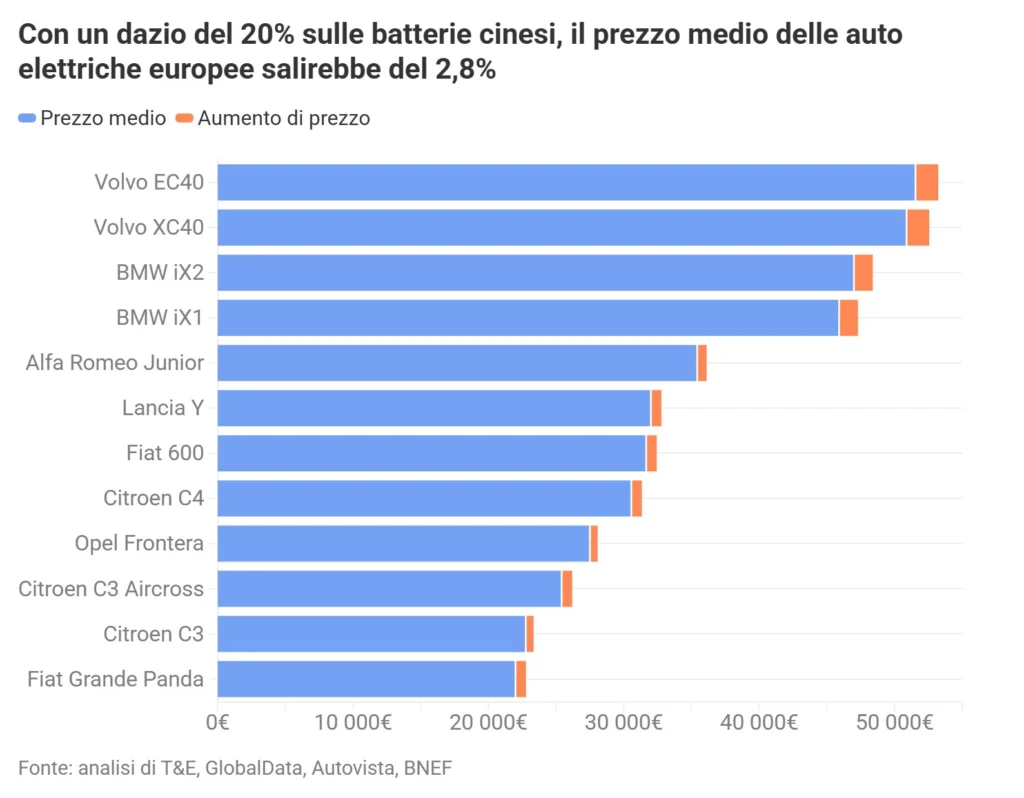
According to T&E, targeted tariff measures could help the continent's manufacturers compete on the domestic market without hindering the spread of electric cars. The organization estimates that a 20% duty on Chinese batteries would determine a average price increase of electric cars produced in Europe equal to just 2,8 %.
The request is that of combine industrial incentives and trade protection, also preventing companies from circumventing tariffs by moving production to third countries. For the association, the European Union should also accelerate theapproval ofIndustrial Accelerator Act and rules on the decarbonisation of company fleets, so as to support demand for vehicles and batteries produced in Europe.
The issue of emissions targets
The industrial issue is intertwined with the revision of European standards for CO2 emissions from new cars. According to T&E, a weakening of the 2030 and 2035 targets would reduce pressure on European manufacturers, slowing the conversion of production to electric vehicles. The analysis examines both the proposal presented by the European Commission and that put forward by European Parliament rapporteur Massimiliano Salini. According to T&E estimates, less ambitious targets could cause the battery-electric car market to stagnate and open up new opportunities for Chinese manufacturers. In the scenario based on Salini's proposal, Chinese brands could reach 30% of the European electric car market by 2035. This share would instead remain at around 15% if the revision proposed by the European Commission were adopted.
"European tariffs have worked, but only in part", he has declared Andrea Boraschi, director of T&E Italia. "Western manufacturers have brought production back to Europe, and Chinese manufacturers have begun investing in local production. However, the competitiveness of the European electric car and battery industry remains at risk." According to Boraschi, "European CO2 emission standards are essential to support the development of the electric vehicle market, but if the EU wants to build a solid battery supply chain, a strategy that combines industrial incentives and adequate trade protection measures will be needed. "