Curated by Francesco Leone, Elena Lissoni, and Fernando Mazzocca, the exhibition "Eternal and Vision. Rome and Milan, Capitals of Neoclassicism"—supported by the Patronage of the City of Milan and produced in partnership with the Bibliothèque nationale de France—offers a broad comparison of Rome and Milan, the two artistic "capitals" of the Napoleonic era: cities projected toward European modernity yet deeply rooted in the legacy of antiquity.
With over 100 works, including paintings, sculptures, marbles, drawings, engravings, and extraordinary examples of decorative arts, from prestigious Italian and international museums—including the Veneranda Biblioteca Ambrosiana, the National Archaeological Museum of Naples, the Museum and Royal Wood of Capodimonte, the Academy of Fine Arts of Carrara, the Querini Stampalia Foundation, the Royal Palace of Milan, the Sforza Castle, the Central Institute for Graphics in Rome, numerous private collections, and the Intesa Sanpaolo collection itself—the exhibition reconstructs a pivotal period in European figurative culture.
"With Eternal and Vision" - he claims John Bazoli, Chairman Emeritus of Intesa Sanpaolo – "The Gallerie d'Italia invite you on a journey into the beauty of neoclassical art, in which Rome, guardian of ancient grandeur, and Milan, laboratory of Napoleonic modernity, return to the forefront. Thanks to the collaboration with prestigious lenders, including the Bibliothèque Nationale de France, we present the public with a fascinating journey that, in synergy with the concurrent exhibition at the Palazzo Reale, contributes to understanding an extraordinary period of Italian and European art."
Rome and Milan at the heart of the new Napoleonic Europe
Between 1796, the year of Napoleon's invasion of Italy, and 1814, the end of the Empire, the Italian peninsula underwent a period of profound political, economic, and social transformation. Within this context, Rome and Milan emerged as driving forces of art and culture:
- Rome, the universal capital of the arts, continues to attract talent from all over Europe thanks to its ancient and Renaissance heritage;
- Milan, capital of the Italian Republic and then of the Kingdom of Italy, established itself as a center of modernity, with the Brera Academy, artistic factories and a lively publishing world driving innovation.
The exhibition brings the two cities into dialogue through ten thematic sections, telling Antonio's creative journey Canova, Giuseppe Bossi and Andrea Appiani.
The Return of Canova's Colossal Horse
Among the masterpieces on display stands out the monumental Colossal Horse by Antonio Canova, A faux-bronze painted plaster sculpture conceived for the equestrian monument to Napoleon intended for the Foro Bonaparte. The monument was never built, and subsequent versions were conceived for Naples, but these projects also foundered after the Emperor's fall in 1814. The model of the horse intended for Ferdinand I of Bourbon—conserved in Bassano del Grappa—survived the Second World War, but was dismantled in the 1960s and forgotten in over 200 fragments. Today, thanks to a major restoration sponsored by the Municipality and Civic Museums of Bassano del Grappa, the Superintendency, Intesa Sanpaolo (main partner, "Restituzioni" project), and the Venice in Peril Fund, the masterpiece is finally visible again in its entirety and welcomes the public at the entrance to the exhibition.
Giuseppe Bossi, Antonio Canova, and the Birth of Modern Italy
An entire section is dedicated to Giuseppe Bossi, theorist, painter, collector, and founder of the Pinacoteca di Brera, and his partnership with Canova. Their collaboration helped define the ideal image of modern Italy, heir to the ancient and protagonist of the new Europe of the arts. Among the most evocative episodes recalled in the exhibition are Giovanni Antonio Antolini's visionary project for the Foro Bonaparte—never realized but crucial to Milan's urban planning—and the coronation of Napoleon as King of Italy in Milan Cathedral, evoked thanks to the display of the Honours of Italy (cloak, crown, scepter, and ceremonial objects), restored by Intesa Sanpaolo for the 19th edition of Refunds.
Appiani's portrait of Napoleon King of Italy
Among the portraits of the Emperor, the one by Andrea Appiani stands out, the undisputed protagonist of neoclassical Milan together with Canova and Bossi. The presence of the painting creates a further link with the major exhibition that the Municipality of Milan is dedicating to Appiani in the spaces of the Reserve Apartment, the Tapestry Rooms and the Hall of the Caryatids of the Royal Palace, open untilOn 11 January 2026.
The Gallerie d'Italia in Milan – together with the branches in Turin, Naples and Vicenza – are part of the Intesa Sanpaolo museum project directed by Michael Coppola, Executive Director of Art, Culture and Historical Heritage and General Director of the Gallerie d'Italia.
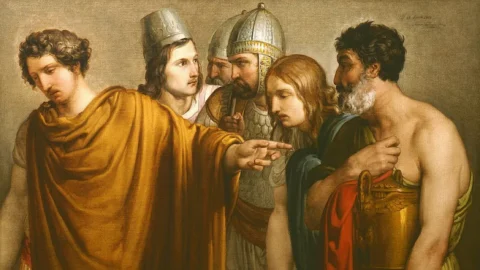
On the cover: The Death of Abradate by Hayez