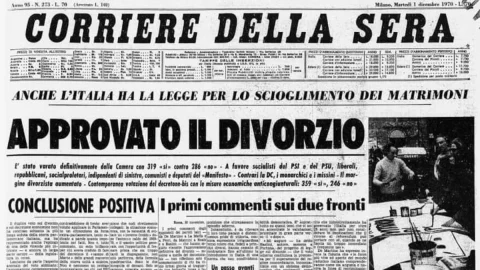
He turns 53 years old divorce law. It was the 1 December 1970 when it was officially introduced into the Italian legal system Law no. 898, "Discipline of cases of dissolution of marriage", developed by Loris Fortuna and Antonio Baslini commonly called Fortuna-Baslini law.
The fight for the recognition of divorce was long and troubled. Several legislative attempts failed previously and only the Italian Parliament in 1970, with the support of the President of the Republic Joseph Saragat, finally managed to pass the law.
The parties in favor and those against
The law obtained approval thanks to the favorable votes of the Italian Socialist Party, the Italian Socialist Party of Proletarian Unity, the Italian Communist Party, the Italian Democratic Socialist Party, the Italian Republican Party and the Italian Liberal Party. The Christian Democrats, the Italian Social Movement, the Südtiroler Volkspartei and the monarchists of the Italian Democratic Party of Monarchical Unity were opposed, however.
The fight for the recognition of divorce continued, marking a period of significant social and legal change in Italian history.
The abrogation referendum
The divorce was widely criticized by the anti-divorce Catholic component that they organized for repeal the law through a referendum. In January 1971, the "National Committee for the referendum on divorce", chaired by the Catholic jurist Gabrio Lombardi, presented a request for a referendum at the Court of Cassation. This initiative received the support of Catholic Action and the explicit support of the CEI (Italian Episcopal Conference), as well as obtaining the support of a large part of the Christian Democrats and the Italian Social Movement.
Despite the initial hesitation on the part of the Radical Party and the Socialist Party about using the referendum for civil rights issues, both supported its holding, actively participating in the collection of the necessary signatures. On the contrary, other secular parties attempted to change the law in Parliament through the Andreotti-Jotti compromise, fearing tensions with the Vatican and expressing skepticism regarding the result of a referendum.
After deposit of over one million three hundred thousand signatures at the Court of Cassation, the request passed the control of the Central Office for the referendum and obtained the admissibility judgment from the Constitutional Court.
Thus it was that on May 12, 1974, the Italians were called to decide on the repeal of the Fortuna-Baslini law. With the participation of 87,7% of those entitled, 59,3% voted against the repeal (NO), while 40,7% voted in favor (YES). As a result, the divorce law remained in force.
The victory also definitively changed the conception of the role of women within the family unit. Although the 1948 Constitution recognized full equality of rights and duties between spouses, the 1942 civil code still reflected a family based on marital power and the subordination of wife and children. The result of the referendum thus also led to the revision of family law by introducing the same rights and duties for husbands and better to agree on the direction of family life and educate children considering their inclinations and aspirations.
Divorce before 1970
Before the 1970 law, divorce existed in Italy but was linked to complex political and social contexts. The first modern Italian state who allowed the divorce was the Napoleonic Kingdom of Italy (1805-1814). In 1805, the “Napoleonic Civil Code” was issued which allowed the dissolution of civil marriages. However, to obtain separation, the spouses had to obtain the approval not only of their parents but also of their grandparents.
La first legislative proposal for the institution of divorce, however, it was presented to the Italian Parliament in 1878 by Salvatore Morelli, a deputy from Salento known for his social commitment. Despite his efforts, the proposal was rejected in 1878 and again in 1880. Subsequently he tried, the government of Giuseppe Zanardelli and presented a bill which provided for divorce in cases of abuse, adultery, and serious convictions, but the proposal was rejected. The divorce debate was resumed in 1920, with clashes between socialists and the Italian People's Party. Mussolini, with the Lateran Pacts, opposed divorce, leading to a 34-year period without further discussion of the law.
After World War II, despite social changes, the influence of the Catholic Church meant that Italy remained without divorce legislation for a long time. Only wealthy people could obtain a divorce through the ecclesiastical tribunal or sentences pronounced in foreign countries.
In the second half of the 1965s, the first social unrest began. The socialist deputy Loris Fortuna presented the bill for divorce in 1970. At the same time, there were the first street demonstrations promoted by the Radical Party and the Italian League for the Institution of Divorce (LID). Thus we arrive at the first of December XNUMX to finally introduce the law on divorce into the Italian legal system.
The conditions for divorce
The art. 1 of Law no. 898/1970 establishes that the judge can pronounce the dissolution of the marriage when "he ascertains that the spiritual and material communion between the spouses cannot be maintained or reconstituted".
The Court must verify two conditions before declaring the dissolution of the marital bond (in the case of civil marriage) or the cessation of the civil effects of the marriage (in the case of marriage by agreement), one of a subjective nature and the second of an objective nature (art.3 Law 898/1970). The competent Court for judicial divorce is that of the residence of the defendant, while in the case of joint divorce the Court of the territory of one of the spouses can be alternatively chosen.
Subsequent changes
In subsequent years, the divorce law was subject to further changes to reflect changes in society.
The legislation on the procedure was modified by laws n. 436/1978 and no. 74/1987. The latter has reduced the time needed to obtain the final ruling of divorce from five to three years, introducing the possibility of consensual divorce, and gave the judge the power to issue a partial ruling quickly declaring the dissolution of the marital bond, separating the final decision on dissolution from the debate on ancillary conditions such as financial issues and child custody. This change was intended to prevent lawsuits filed solely to delay divorce.
Later, the law n. 55/2015 has further reduced the time, allowing divorce (the so-called short divorce) after one year of judicial separation and after six months of consensual separation.
Recently instead, quick divorce was introduced. With the ordinance of 16 October 2023 n. 28727, the Supreme Court established the possibility of presenting a request for separation and divorce through a single legal document, while maintaining the criteria of assignment and maintenance.
Divorce laws in Italy
Here is a list of the main legislative provisions regarding divorce issued in Italy:
- Law 898/1970 – “Discipline of cases of dissolution of marriage”
- Law 436/1978 – “Supplementary provisions of law 898/1970, on the regulation of cases of dissolution of marriage”
- Law 74/1987 – “New rules on the regulation of cases of dissolution of marriage”
- Decree-Law 132/2014 – “Urgent de-jurisdictionalization measures and other interventions for the definition of the backlog in civil proceedings,” converted with amendments by Law 162/2014
- Law 55/2015 – “Provisions regarding dissolution or termination of the civil effects of marriage as well as communion between spouses”
Lastly the judgment 28727 of 16 October 2023 which states the principle according to which "in terms of family crisis, in the context of the procedure referred to in art. 473 bis 51 cpc, the appeal of the spouses proposed with a joint and cumulative request for separation and dissolution or termination is admissible of the civil effects of marriage".