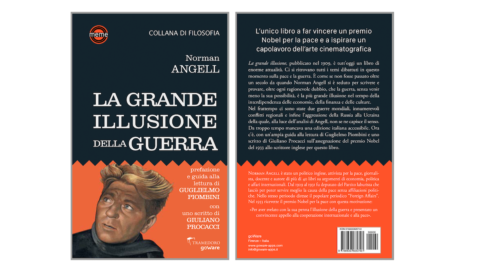
Back available to the Italian reader, in all formats, a book that had a great fortune between the two wars and that brought its author, the English journalist and activist Norman Angell, to obtain the Nobel Peace Prize in 1933. It is a book that has not lost its enormous relevance.
This is de The Great Illusion which goWare and Tramedoro have re-published in a new edition with an extensive reading guide by Guglielmo Piombini and an essay by Giuliano Procacci which reconstructs the circumstances and the debate that led to the awarding of the 1933 Nobel Prize to Norman Angell.
The first edition of the book dates back to 1909 and was such an immediate success that it was translated into 25 languages including Italian. In Italy it was released in 1913 by Enrico Voghera Editore, edited by Arnaldo Cervesato.
The central thesis of the book is that in the modern economy and society, war damages both the victors and the vanquished.
This is for one simple reason. In the capitalism modern economies are so interdependent as to make the world an organic unity and no longer the sum of many parts that share a space that tend to contend.
Angell wrote, as early as 1909, that a sneeze in New York became a cold in London and a flu in the rest of the world.
More simply, in Angell's scheme, the recourse to war is a useless act, superfluous, totally harmful for those who undertake it and for those who find themselves subjected to it.
We asked Guglielmo Piombini, author of the extensive reading guide to Angell's text, to present the salient theses of the book for our readers. The text that follows him explains them very clearly.
Le thesis of the book in points:
- The wealth of a country does not depend on its political or military power.
- Given the close economic interdependence that has arisen between nations, war has become anachronistic.
- It is a "grand illusion" that a country can become richer thanks to a victorious war
- Military conflicts disrupt the financial and credit system, harming both the victor and the vanquished country.
- A country which destroys or subjugates another also destroys its own market.
- The banking system represents the nervous system of the world economic organism.
- Small countries without political power are more prosperous than big powers.
- The general tendency of humanity is to replace conflict with voluntary cooperation.
The futility of war
One of the most deeply rooted misconceptions of men at the beginning of the XNUMXth century, observes Norman Angell, is that according to which the economic wealth of a country depends on its political power. Many Englishmen, for example, are convinced that the strength of the British Empire underlies its commercial success, just as many Germans believe that Germany's industrial development is due to its recent military successes.
Even pacifists often don't dispute the idea that war is good. It is for this reason that the propaganda for peace has failed and that public opinion in Europe, far from curbing the tendency of their governments to increase armaments, pushes them to ever greater expenditure. Yet, writes Angell, it is a very dangerous error which, if not eradicated, can jeopardize the existence of our own civilization.
In the past, looting and military conquests could improve the conditions of a country, but today the situation has completely changed. Given the close trade interdependence, the destruction of an enemy nation's economy would disastrous effects also on the economy of the conquering power.
The interdependence of companies
We must never forget that each producing country, in addition to being a competitor and a rival, is a customer and a market. If one nation completely destroys another nation's industries by military means, it ruins its own actual or potential market; this would be commercially equivalent to suicide.
The Germans would not get no advantage not even if they enslaved the entire English people. In fact, where does the English wealth that seduces the Germans come from? Essentially from the profits of its economic activities.
And how could there still be such profits, if the population is enslaved, and can no longer consume and produce freely? If the German torturers want to take these profits, explains Angell, they must also allow their production. If they allow it, they must let the English population continue to live exactly as before.
An ante litteram globalization
The development of the international trading and economic interdependence between nations have therefore made war entirely anachronistic. This interdependence arises from the development of the economy, trade, finance, credit and communications, which make a disturbance in London almost immediately felt in New York or Berlin.
In particular, Angell explains, the banking organization supplies the entire international economic organism with the sensory nerves, which make the reactions of the markets to political events almost immediate.
What is obvious to a banker or a businessman, that shirking one's commitments or attempting financial plunder is stupidity which amounts to commercial suicide, it should also become obvious to the rulers. Commercial development, therefore, makes manifest a profound truth: that the effective basis of social morality coincides with self-interest.
Colonialism and imperialism are outdated
La military force, therefore, increasingly misses its purpose and has now become completely useless. If at the beginning of history a plundering state could inflict great damage on another without suffering from it, today a state cannot cause even remotely comparable damage to that of ancient times, without provoking a disastrous reaction against itself.
Four centuries ago England might have seen all her rivals annihilated to no detriment to her; today such a fact would mean the most terrible famine.
All these considerations can be summarized in one: that the only policy that a conqueror can follow is that of leaving the territory in complete possession of the individuals who populate it. Consider synonymous with enrichment for a nation the conquest of new territories it is therefore an error of logic or an optical illusion. There is therefore no way for the inhabitants of a country to derive an economic advantage from the possession of a colony or an empire.
Power politics
However, the "experts" explain that military and commercial security are one and the same, and that armaments are justified by the need to guarantee trade; they claim that a country without a military force to serve as a base for diplomatic negotiations in the consultations of Europe he finds himself exposed to very great disadvantages.
Yet, Angell observes, when a capitalist studies the question from a purely financial point of view, and has to decide whether to invest his capital in large states, with all their apparatus of colossal armies and fabulously expensive navies, or in small states, who have no military strength, he gives preference to the small and defenseless state.
Looking at quotations, investments in Belgian, Norwegian, Dutch and Swedish stocks, unwarlike nations and at the daily mercy of their colossal neighbors, are ten to twenty percent safer than those of mighty Germany and the Russian empire.
The prosperity of small states
The reason is that in the modern world the wealth, prosperity and well-being of a country do not in any way depend on its political power or its territorial extent. This is demonstrated by the fact that the minor nations such as Switzerland, Belgium, Holland, Denmark or Sweden, which do not exercise any political power, enjoy a level of commercial prosperity and social welfare even or more than to that of the great nations of Europe, such as Germany, Russia, the Austro-Hungarian Empire or France.
The Dutch citizen, whose government has no military force, is on the average wealthier than the German citizen, whose government has an army of two million men, and much wealthier than the Russian citizen, whose government has about four million. under arms.
Trade and economic prosperity are simply won producing higher quality goods or cheaper than its competitors, while the presence of a powerful navy can in no way help exports or ensure the conquest of a market. Switzerland doesn't even own a warship, but its productions often drive out those of English manufacturers.
Other non-economic justifications for war
When they fail to refute economic arguments, advocates of war defend it on psychological grounds. War, they say, is in the nature of man, who always has and always will. On other occasions militarists argue that nations do not go to war for economic reasons, but for spiritual and ideal reasons, or for irrational reasons concerning vanity, prestige or the desire to excel. However, Angell replies, it is not at all true that war arises from uncontrollable aggressive impulses inherent in man, given that it almost always requires a long preparation.
On the contrary, the historical evolution of humanity sees the passage from the method of extermination of the vanquished to that of the imposition of taxes. Today humanity is realizing that this system too it costs more than it pays off, because the expense of extorting money by military means exceeds the amount of the extorted sum. The end result is the complete abandonment of force in favor of mutually beneficial voluntary cooperation. Every step forward in human cooperation is therefore synonymous with civilization.