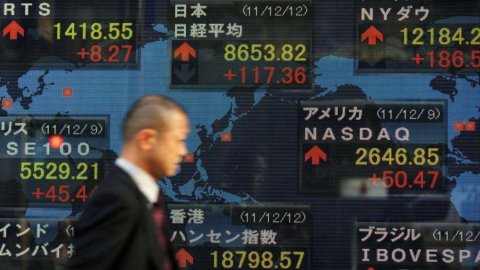
Paradoxically, the bad news of the day—Japan's GDP unexpectedly contracted, albeit by only 0,1%—boosted the Tokyo stock market, as this weakness raises the likelihood of Shinzo Abe's government adopting (or, rather, adopting) the ultra-expansionary policy. Even the caution displayed by the Bank of Japan at today's meeting mattered little: the terms of the governor and two of his deputies expire in just over a month, and the likely replacements are all on the prime minister's side.
The Nikkei rose 0,7%, and the MSCI Asia Pacific regional index gained 0,4% in early afternoon trading in Hong Kong. The European single currency remained stable at $1,345 against the dollar, and the yen cautiously resumed its attack at $94. Gold remained weak, holding below $1650 an ounce. It's tempting to say that when the economy improves, gold deteriorates, because it thrives on crises, but this, too, isn't true. The price of gold's fluctuations follow inscrutable paths, making it one of the most volatile assets in a portfolio.