

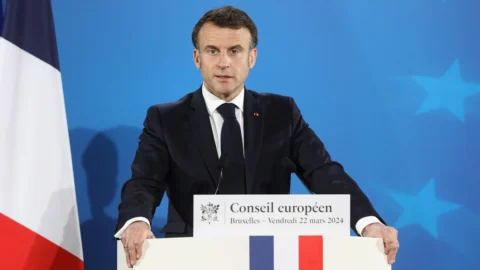
Where have all the soloists gone who for fifteen days boastfully intoned the de Profundis di Emmanuel Macron and ruled that his decision to dissolve the French Parliament was pure madness and would inexorably deliver the France to the far right pro-Russian Marine Le Pen? If they had intellectual honesty they would have to apologize not only to Macron, who certainly paid for his sentimental divorce with a part of the population, but to all citizens and answer a few simple questions: 1) without the suddenness with which the French Parliament was dissolved and without the speed with which the anti-Le Pen republican alliance was built after the first round of the political elections, would the rise of the far right have been halted? And it would have been formed, despite all its internal contradictions, the Popular Front? The answer is no.
Without Macron's one-two Le Pen would have won with all due respect to most pollsters and a large part of the press. Fortunately, reality is different from how they told us, because politics is intelligence, audacity, quick thinking, imagination, the complete opposite of the mental laziness and conformism that often dominate the scene. With the vote on 7 July, democratic France won and the far right lost, which until the end winked at Putin and he tried in extremis a makeover to calm the markets but which did not convince the vast majority of French people. And with the victory of democratic France, theEurope.
Now, however, the second half of the match begins because from the polls comes the victory of the Popular Front, the recovery of the Macronians and the defeat of the Lepenists but on paper, according to the first delirious declarations of Jean Luc Melenchon, no parliamentary majority emerges because the populist leader of LFI has ruled out any agreement between his group - which collected only 71 votes of the 180 of the Popular Front, just 7 more than the Socialist Party of Raphael Glucksman – and Macronian forces. But the games have only just begun and Macron will have to wisely choose the new prime minister to facilitate the formation of a reformist and pro-European majority. We are at the beginning of the second half of the match but we can breathe a sigh of relief. Good morning starts in the morning.



This article is perfect for the “Famous Last Words” column of the puzzle magazine, since Macron himself, in his end-of-year speech, declared that the idea of dissolving parliament was not good for the country, taking responsibility for it.
In the second round of the French legislative elections on July 7, most polls predicted Le Pen would triumph, but that was not the case: the lightning-fast dissolution of Parliament objectively stopped the far right from advancing, and Le Pen came in third, overtaken by the new Popular Front and the Macronian center. These are the facts and there is no getting around them. At that point, it was up to the new Popular Front and the Macronians to complete the job and form a center-left government and checkmate Le Pen. Mélenchon's maximalism made impossible a political operation that would have guaranteed the governability of France and the marginalization of the far right. Macron's partial self-criticism now is the result of another political season in which the President of the Republic is trying to tone down the bitterness between the democratic forces in the hope of a difficult national reconciliation.
Yes, because Mélenchon has become unpredictably maximalist (but who would have ever said it? It was a surprise that none of the political scientists had even remotely imagined!). If the government forces manage to dissatisfy their voters so much that the “anti-system” forces become the majority (on both sides), it is useless to cling to power, but to let them run their course, including any damage (as happened with the famous yellow-green government) and then they will deflate, as happened to the two parties of that government. Macron's choice was a clever move that even a self-satisfied person like Macron had to admit was a donut without a hole and that ultimately led to the worst (humiliating) French government crisis. The French majoritarian electoral system has always worked well as long as “my people” won and is it no longer good if “the others” win? And then we change it by switching to proportional representation, if we have the strength to do so. If at a certain point you are no longer capable of obtaining popular legitimacy with the current electoral system, you have to move to the opposition and from there give them a hard time, not try to demonize the opponent or prevent him from governing with similar "Italian-style" tricks. Far from winning the bet: the current situation is derived precisely from that risky and ill-advised choice that now Macron himself has finally admitted, reluctantly, to have made a mistake.
I would advise being less assertive because the evolution of the French crisis may still hold surprises.